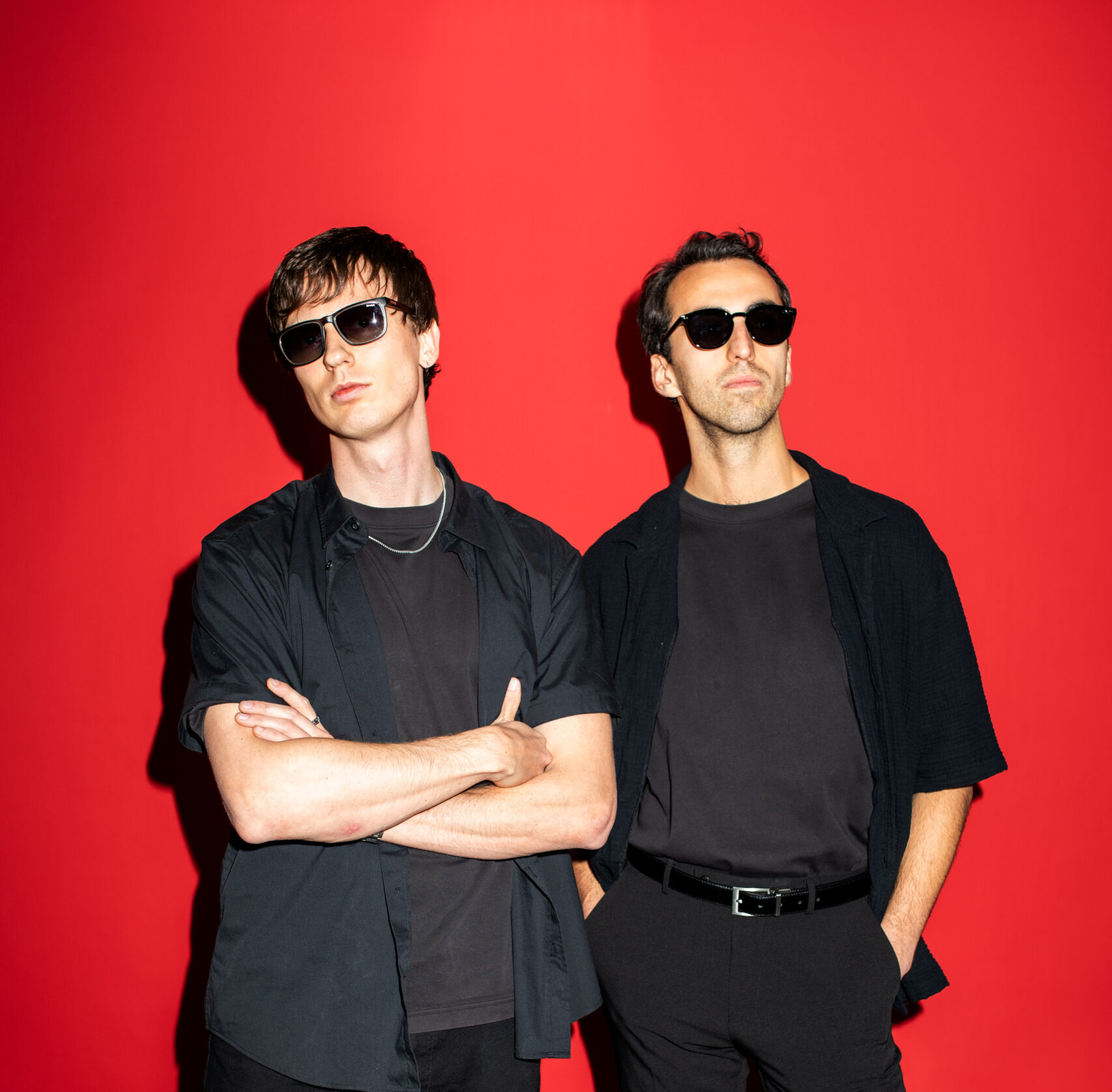
T & Sugah start off 2026 with all cylinders firing. ‘Call the Police‘, with Takura on mic duty, is out now on UKF.
As far as words can go to describe this new banger; stabby frog-sounds engineered to sonic prowess for maximum impact? Check. A vocal hook that unapologetically moves into the rent-free space in your head? Check check.
Fair to say that the result instantly hits home on first play. It’s up there with their stuff, marking another contagiously catchy gunfinger anthem by Dutch tea-loving drum and bass-duo.
All about that ‘forget your name, leave your worries behind, and fucking-lose-it’ type of moodbooster music-ish.
And after tracks like ‘Lo Lo’ and ‘The Formula’, which hit massive numbers on TikTok, ‘Call the Police’ reaffirms their renewed take on the genre is spot-on.
What’s more: ‘Call the Police’ is only one of the red-hot embers from T & Sugah’s kitchen that will propel their presence to even more prolific heights during this year.
So let’s get on with it, for there is plenty of ground to cover in this long-read interview below, like the upcoming 10-year anniversary celebration of their High Tea label… Dig in!
Welcome back! Tell us more about the conception and workflow behind ‘Call the Police’ with Takura on the vocals.
Philippe: This one was actually kind of interesting, because often there are two ways you can work together on a track. The way we worked on ‘Call The Police’ with Takura is very different from how we worked with Irah recently. Off topic, but funnily enough both are vocalists on Baddadan. Basically these two are very clear examples of different directions. With Irah, we sat down in the studio together in London to write and record something on the spot.
With Takura, we actually sent him this idea we had, the instrumental, and he wrote a topline for it. Takura sent it back, then Robin actually rewrote part of the vocal. We pinged our ideas back and forth until he recorded the final version. He wasn’t even in England when he recorded it. It just shows how international and non-geographically bound these collaborations can be. If the music resonates, you can work wonders.
So you sent the instrumental and he worked with that?
Philippe: We’re producers, logically. We can sing, but you don’t want to hear us sing! Sometimes we record a little example to send to a vocalist, but no, we created the instrumental, everything apart from the vocal, and sent that over. Then they do their trick on it.
So that went quite smoothly with him?
Philippe: It was so smooth. He sent out his first idea, this whole ‘Call the Police’ concept, and we loved it from the second we heard it. I was so excited. We were like “this track needs to be finished”. Because, the thing is, often you start tracks, and you end up not finishing them. Actually, most of the tracks we start, we don’t finish. But with this one, we were convinced from the start.
Looking at your recent successes, especially on TikTok with ‘The Formula’ and ‘Lo Lo’, was there a conscious approach to getting the hook right to make it viral? Or was it more the fruits of your labor and getting into the flow?
Philippe: I think you should never let virality influence the music. The biggest lesson we learned is that if you try to create something to go viral, it’s often the worst stuff you create. You gotta create what you really enjoy, and hopefully, it resonates. We never tried to create something purely for TikTok for instance.
Robin: Perhaps in one small way, but in a good way, we did learn from TikTok. We realised that music on social media that resonates with the listeners, it often has the drop and the main part of the hook coming together at the same time. So when the song drops, it’s the chorus of the vocal as well. We tried to implement that structure a bit more, and I think it makes more sense musically in most cases. So in that sense, thinking about social media has had a good influence on how we structure music.
Philippe: Interestingly enough with this track, it was Takura’s idea to put the chorus on the drop. He sent us the version with the ‘Call the Police’ chorus right on the drop and we loved it. But indeed, what Rob is saying is a good development.
You guys made your name with a more chilled-out, melodic vibe. This track is going away from that to some degree. When and why did you decide to turn it up a notch?
Philippe: I think we’ve been moving away from the purely melodic sound for a few years already. Everything after ‘Danger’, I think that was the end of 2023, had this heavier ring to it. That’s simply because we enjoyed that more.
Robin: To be honest, we’ve always been fans of harder drum and bass; stuff that works melodically, but also goes really hard in the club. For a long time, we didn’t really know how to implement that in our own sound. It’s easier to write songs with basic sounds, but to produce a song with experimental or harder sounds is difficult to get right. Around the time of ‘Danger’, it came together. We learned new production techniques and changed our style. The rise of “melodic jump up” really resonated with us, because it combined that harder club feeling with being melodic.
Philippe: We always tried to write for both the rave and the headphones. But before ’23, actually, we did write some heavy tunes. There is even some neurofunk in our back catalogue. But somehow those tracks never really popped off, so people only knew us for the liquid stuff.
Robin: That’s what I mean: we didn’t have the skill yet to make it work with our ideas. We tried, but it didn’t blow up.
So it was a period of refinement. Looking technically at ‘Call the Police’, were there certain things that reflect that evolution in sound design?
Robin: Since I’m the sound engineer, I’d say this is the first tune where we really embraced the ‘frog’ sounds, along with the foghorns. That is characteristic for this track. Combining that with a great MC vocal gave, it was something extra, so it wasn’t just a dime-a-dozen jump-up track. We really embraced those froggy sounds, which we held off on for a bit, because we didn’t know how to make them work. In this case, it finally sounded right to us.
Philippe: It’s also just part of the grind. You keep trying new things, and at some point, you hit the jackpot. Part of it is experience, part of it is sheer luck.
I guess you already had the chance to try this track live. How were the reactions?
Philippe: That’s the funny thing: I already expected it to be wild, and it was exactly that. The moment I heard the track myself… when you get excited about a track yourself, you already know.
Robin: We played older versions with demo vocals where we tried different mixes, but the final version goes really hard.
Philippe: It was a hell of a job to get the mix right, but in the end, it sounds spot on. It is exactly in that sweet spot where you can listen at home but also rave to it.
Robin: I don’t think frog sounds are meant to have vocals on them usually, because they both really have a presence in those high mids. That made it hard to make it work, but I think we did, so I’m happy.
The hook is great. After doing the numbers on socials, with the explosion of your previous UKF tracks, do you feel a certain pressure now? Or is it just ‘get on with the job’ and focus on the studio work?
Philippe: In a certain way I do experience more pressure, because the stakes are higher. Along with success comes a responsibility to keep doing better and breaking your records. You want better music, better collabs, better shows, and better streaming numbers. But actually, the key is: even though the pressure is on, you’ve got to tell yourself to enjoy the process.
Robin: It’s double for me. I recognize the pressure Philippe is talking about, but before the rise, we’ve had over the last two or three years, we hit a ceiling for a long time. We were doing okay, but there wasn’t really momentum. Keeping it going for years and then finally getting that momentum showed me that even if we get stuck again, if we keep going, there can always be a breakthrough moment.
Philippe: If we weren’t that consistent and persistent, it would never have happened.
Makes perfect sense. Tell us about your upcoming 10-year anniversary of High Tea
Philippe: This year is going to be a reflection year for us, because 10 years of High Tea is quite a lot.
Robin: It’s crazy. It doesn’t feel like 10 years ago; time flew by.
Philippe: It’s wild to think that our label and event company is 10 years old. I’m very happy we get to celebrate this at the Melkweg on the 28th of March. I’m very proud of the team and the lineup we’re putting together.
Six rooms of drum and bass…
Philippe: Yeah, six rooms. Three rooms with music and three rooms with drum and bass affiliated things: like an art exhibition and a room for activities like speed dating. Personally, I’m very proud that we have a full-blown cinema. We’ll be playing concert movies all through the day/night centered around rave culture, but also touching on sensitive topics, like rave culture in Iran where parties like these are illegal. We try to bring awareness next to standard festival programming.
After 10 years, how has the meaning of the brand evolved for you?
Robin: It definitely has gotten bigger and better. It started as a small, local party in our hometown, and now we’re doing parties throughout all of Europe. It’s been a lot of growth. It’s also interesting to see how the team grew. We started with just the label, and now we have a publishing branch and a booking agency called Tea Leaves.
Running a label and events can be a full-time job. Did it ever come in between the responsibilities of T & Sugah?
Robin: It’s always been a struggle to balance it, especially when we were studying. I would say now, for both of us, we have a pretty nice balance. It actually enhances each other. Because of High Tea, we get in touch with a lot more people in the scene, which is nice for T & Sugah for finding collabs. And T & Sugah adds to High Tea.
Philippe: They feed each other in a very good way. Honestly, there is so much credit to go around after ten years. Beyond High Tea, UKF has played a very big role in the story, as well as Liquicity and DnB Allstars.
Robin: And shout out to our booking agent Ivo Mayfield, who is absolutely stacking the calendar, and our label manager Daniel Schrijvers.
Looking at your status now, how do you see High Tea fitting into the Dutch ecosystem of drum and bass?
Philippe: High Tea has an interesting role, because we’re the only Dutch brand that does it all: the label, the events, the agency, and even a bit of management. We can provide a full package to upcoming artists. If you join our agency, you play our shows. If you release good music, the agency might pick you up. It becomes an environment where new artists can thrive.
Robin: It’s funny how we moved from a small local party to being one of the main organizations in the Netherlands, alongside Liquicity, Korsakov, and Blackout. I think we are one of the few that do so much regarding the full package: label, events, and agency. It’s important to have that, so small artists have a chance to connect and get further in the scene.
While times haven’t been easy since the pandemic, is this collective momentum something that really helped you to thrive where others might have failed?
Robin: Yeah, I would say it was really helpful to have High Tea, even though events weren’t really a thing for a while.
Philippe: I think COVID showed us that every crisis can be an opportunity. We came out of COVID way stronger than how we went into it. Some other brands did as well, while others didn’t. It’s interesting how a pandemic can separate people with different mentalities. Our approach was: we’re just going to do every single thing we can. If the regulations allowed for ’A,’ we did ’A.’ If they only allowed for ’B,’ we did ’B’.
We did the craziest things: volleyball matches, seated raves, live streams. For the sit-down shows, people had to sit on chairs apart from each other, but at least they were there.
Robin: I think the craziest one we did was volleyball, or actually dodgeball. At one point, only sports events were allowed, so we organized a dodgeball tournament where we just put a set of speakers and a DJ setup in the middle. Suddenly, it was a sports event. Staying present throughout the whole of COVID is what really gave us a big boost.
Philippe: Exactly. At one point, we were the only event happening in the entire country, because we organized an event that ended exactly one hour before they became illegal again. We even had a night where the old rules were stopping and the next rules were starting, and there was a window of maybe eight hours. So we threw a party in that window! When only outdoor events were allowed, we did a party on the beach. We’ve been very fast and flexible with organizing. With the right ‘go-get-it’ mentality, you can come out stronger. People were so appreciative of us trying to keep things alive.
It’s a road less traveled at uncertain times, but the view was great for sure. Obviously, part of the High Tea legacy is breaking new talent. Are there any specific artists you booked early on who are headlining major events now?
Philippe: One of our proudest is Andromedik. We released Andromedik’s very first track. I’m also really proud of Arcando; he actually transitioned from house to drum and bass with us, and he’s been killing it ever since.
Robin: Personally, I’d say ATMOS.
Philippe: He’s about to become one of those big names. We scooped him up ages ago, but he’s really getting there now.
Robin: SKIYE is a new one that I’m personally a big fan of. He has some real bangers.
Philippe: Indeed. He already has support from K Motionz, Kanine, and all those names. Kanine played his track in a very early stage of his career!
High Tea has been praised for that ‘living room vibe’ and the tight-knit community. As the brand scales up to a massive scale with these takeovers, how do you keep that intimate feeling, without losing the crowd?
Philippe: That is always a challenge, I’m not going to lie. I think part of it comes down to our decoration. We religiously hold onto these little details, like the desk lamps we put on the DJ booths with our logo embroidered on them. Those details matter.
Robin: It’s also in the side-activities we have at the festival. At a certain size, you can’t really make a massive mainstage feel like an actual living room anymore. So, we make sure we have smaller stages or activities that have that intimate vibe.
Philippe: For instance, I love the speed dating activities we do at our events. It keeps that human connection alive.
So what is the plan for the next ten years with High Tea, are you planning to do more abroad?
Philippe: I think there are two pathways. One is moving more outside of Holland and even outside of Europe. We have a few ideas in the pipeline that I’m excited about. Within Holland, we are still gradually scaling up; that’s always been our thing. We aren’t the kind of guys who try to go 10x in one go; we grow every step of the way.
This upcoming ADE (Amsterdam Dance Event) is going to be our biggest yet. I can’t even talk about it fully yet, but we are really doubling down on tickets for this ADE.
We are also scaling up our 013 show (in Tilburg, The Netherlands) and our summer festival. Interestingly, our summer festival used to have the main stage indoors with the rest of the terrain outside, but now we’re moving the main stage outside too, which increases capacity again.
Every year we go bigger, but it is carefully planned. You want to avoid going too big too fast and falling; that kills the scene. You need to grow steadily so people can count on you.
Thank you for clarifying.
And congratulations on locking such a massive world tour in 2026; that must be a career highlight.
Philippe: It’s funny you mention that, because I always thought the end goal was a world tour. Now we’re doing them and I’m like, “What the fuck is next?”
Robin: It feels so normal now, in a way. But I still have those little moments where I realize how crazy it is that people fly you to the other side of the world just to hear you play your music.
Philippe: One of us is on a different continent almost every month now. If it’s not Australia or New Zealand, it’s Asia, Canada, or America. I’m still playing with the idea that one day we should bundle a run of shows together and officially call it a “World Tour” just to have the flyer for it. We could print that out and hang it up haha. But, yeah, we are already doing world tours. It’s wild to see where the music brings you, especially considering we started in a little room at Robin’s parents’ house.
Robin: Our goal was always just to make a living off this so we could keep doing it. We’ve reached that goal. Now it’s about seeing how much further we can take it, making the music and the events better every year.
Philippe: Our first goal was very pure: we just wanted to live off it because we loved it. That feeling is the same, but now we want to see how far we can push it. You realize you aren’t just changing your own life; you’re touching other people’s lives.
When we were recording the video for ‘Call the Police’ in Rotterdam recently, we got a bunch of fans together. We went into the subway and did a sort of mini illegal rave to film their reactions to hearing the track for the first time. It was such a pure moment: all these people were together, sharing a moment that wouldn’t have existed without this song. Music becomes bigger than us like that.
Robin: I was so grateful those people wanted to help us with the video. In return, they told us how thankful they were to work with us and have that day with other fans. The energy goes both ways.
Philippe: You get energy from the fans, you give it back, and it goes around. You touch people’s hearts and you might not know them, but they know a part of you already.
Robin: Exactly. We’ve experienced this ourselves, getting to know the artists we looked up to for years as actual people.
Full-circle stuff indeed, is studio time on the road a thing, or do you keep it separate?
Robin: We usually have one weekly session together. During the rest of the week, we both know our individual tasks. It is definitely harder to find those moments when there’s a tour. We keep in touch through calls to discuss what needs to happen, but it’s best when we can sit together in the Netherlands.
Philippe: We are playing with the idea of streaming our studio sessions more, which would allow us to collaborate even when we are in two different countries. Logically speaking, the schedule is probably only going to get busier.
Philippe, have been to China to play. What was the most surprising thing about the Drum and Bass culture there?
Philippe: The energy of the crowd. I used to say Amsterdam had the best crowds, but Chinese crowds are right at that level. It’s a different energy, though. In China, they are raving on sheer joy and gratitude because it is so rare for international artists to travel all that way. They are so grateful to actually see a performer play the tracks they listen to. The scene is small, but the gratitude is massive.
How does it feel to come back to Amsterdam or Melkweg for a homecoming set?
Robin: It’s always special. Playing a big Dutch festival or our own High Tea party feels extra great, because we finally get to play together after being apart on solo tours.
Philippe: I low-key really enjoy playing together, because I can actually relax!
Robin: It’s so much easier. When you play solo, you’re stressing about making a mistake, but when you’re together, if one person messes up, the other one almost always catches it.
Philippe: Exactly. I enjoy playing solo too; it’s like a “top sport” where you are incredibly focused because there are no breaks, but it’s also nice to have those breaks when you’re a duo. You can check the other person, grab a drink, or just look at the crowd and enjoy the moment. It’s the best of both worlds.
Are there things you’ve learned after all these years that are really non-negotiable when it comes to surviving on the road?
Philippe: Veggies and fruit. I just fall apart if I don’t eat properly.
Robin: When I travel, I just take my multivitamins and I’m fine, especially if it’s not for weeks and weeks on end.
Philippe: Well to be fair: it’s mainly in the US where I tend to fall apart.
Robin: That’s true, I haven’t been there yet, so maybe that’s it.
Robin: I would say the main thing is making sure everything is arranged. Sometimes you work with organisations where, until the very last moment, you have no idea if you’re getting a pickup or what the deal is. These days, we make sure that before we board the plane, everything is settled and we know exactly what to expect.
Philippe: Exactly, that’s the key. And also ensuring they actually have the right CDJs and equipment. That is non-negotiable. If they don’t have the right decks, I am going to be extremely frustrated.
Robin: Last year I had a set where I was playing new material, so I really had to focus to ensure I didn’t make mistakes. They set me up with three really old CDJs; I think they were the first ones that even had USB ports. That definitely made everything harder.
This is like the non-negotiable ‘holy scripture’ of the rider…
Philippe: Exactly. It is literally in the rider in red, underlined, and in bold. That’s the only thing styled like that; the rest of the rider is in normal black text.
A decade ago, it was all about making tunes and mixing. Now, looking at viral stats and social media, you guys have also become content creators. How do you feel about that shift, does it feel like a necessary evil?
Philippe: We learned that in the beginning, it felt like a necessary evil, but you have to find a way to actually enjoy it. Once you find that, the ‘evil’ feeling goes away and it just becomes a fun, new aspect of the job.
The only problem is time management. This takes a lot of time, so you have to find the right balance of when to invest in what. But most importantly: find a way to enjoy it or it will break you.
Robin: I second that. You have to find a way to go with the times. I fully understand why people complain, saying the job should just be about the music, but this is the reality of the industry.
If you just want to make music and skip the extra stuff, that’s fine, but then it should be a hobby. If you want music to be your job, you have to accept that with any ‘fun’ job, at least half of it is going to be business and promotion. Sometimes it’s 20% creative and 80% business; that is what makes it a career. You have to work for it.
It definitely takes a bite out of your creative energy. If you can’t protect that, it could have a negative impact
Robin: It works both ways. I had a period where I was making music for 10-plus hours a day, and you can get isolated in that bubble. Having a social life and other work, like what I do for the High Tea label, can actually be more stimulating. It brings you back to the music fresh and helps me be more creative.
That makes sense. So what happens when you hit a deadlock in the studio about a decision? Do you flip a coin or does someone have the final say
Robin: We usually just let some time pass. If Philippe suggests something I’m not feeling, we let it sit for a while. A couple of days later, I’ll look at it again and realize he actually had a point, or sometimes not.
Philippe: Our main weapon is time. When you are deep into the music, you can’t always see the truth; you have to zoom out. It’s a skill you can teach yourself, but the best way to do it is just to step away. You come back a week later and you both immediately hear the solution.
Robin: We had a perfect example last week. We were working on a new tune and had an instrumental first drop. Philippe suggested adding the vocal there as well. At first, I didn’t pay much attention to it, but later I replayed the whole track and realized he was right. We never really fight; we always find a nice middle ground.
It’s interesting because you can easily fall into your own tunnel vision, even together. Giving it some rest is a great tip for other duos or trios.
Robin: It’s one of the most important things in production. When you’re less experienced, you might think something sounds amazing in the moment, but later you realize it’s too much. Over the years, you gain that experience. Coming back fresh allows you to immediately hear what sounds off.
What is the biggest lesson you’ve learned about staying relevant without losing your core identity as artists?
Robin: Staying connected with new talent. You can get stuck in the ways you learned ten years ago regarding sound design and approach. We love working with new talent, because they have a fresh view on the tools that have only recently become available. We’ve learned a lot from working with some of the new jump-up guys. It works both ways: they get our experience, and we learn from their fresh perspectives.
Philippe: I totally agree. It’s beneficial for everyone. We can learn from the old-school guys just as much as the new ones. Music is about challenging your own perspective; if you do the same thing for too long, you won’t enjoy your own music anymore and it will start to sound like all the same to you. Drum and Bass is a great example of a genre that keeps evolving. If it didn’t, the listeners would be bored and the artists would just be writing the same track ten times.
What mistakes do you see upcoming artists make that you would warn them about?
Philippe: Don’t force it. Don’t think ‘I have to be this’ or ‘I have to do that’. Trust your intuition and be yourself.
Robin: Whether it’s the music or the videos you record for social media, you have to be yourself and enjoy the process. Regarding production, I see a lot of producers who want to do everything from scratch. They insist on doing all their own sound design, but then it doesn’t sound great. Just let it be about the fun and the music. It doesn’t matter if you use samples or presets; what matters is the final result.
If you can design something nice yourself, like drums, that’s great, but don’t force it. This is where AI ties in too: it’s just another tool. You don’t need to create every single element yourself; being a musician is about curating. If an AI tool creates a small element that works perfectly in your track, use it. I’m not saying you should make an entire song with AI, but it’s a great way to play around and have fun.
What does success mean to you these days? Is it happiness, legacy, or the ability to give back?
Philippe: That’s an interesting question. Achieving what you dreamt of is one thing, but then what? Once you’ve achieved it, the goalposts move.
Robin: Success is relative and depends on your goals. For me, I think we are already successful, because we love what we’re doing. We want to continue doing what we love and, as we said earlier, make a living off of it.
Philippe: Our original goal is achieved, so that is success. But then the goal becomes a world tour. You do that, and then the goal is to do it again but bigger, with bigger crowds and lineups. Success is constantly moving. It’s good to look back on your previous goals and realize: “We used to define success as that, and we’ve achieved it.”
So how does gratitude relate to this?
Philippe: I would rather inspire the next generation. Thankfulness is important, but I really enjoy seeing continuation and legacy: seeing something being built, carried, and continued. That is maybe the real definition of success; one day you won’t be able to tour anymore, but to see this whole thing thriving and all the artists you had under your wing doing beautiful things, that is success in the end.
In conclusion: A shout-out to both for a great synergy during this interview. And as Philippe and Robin move the goalposts yet again, don’t miss a beat of their crime spree. There’s plenty to see, hear and experience from the tea-sipping duo in the year ahead, so be sure to follow their socials to stay in the loop, bless!