
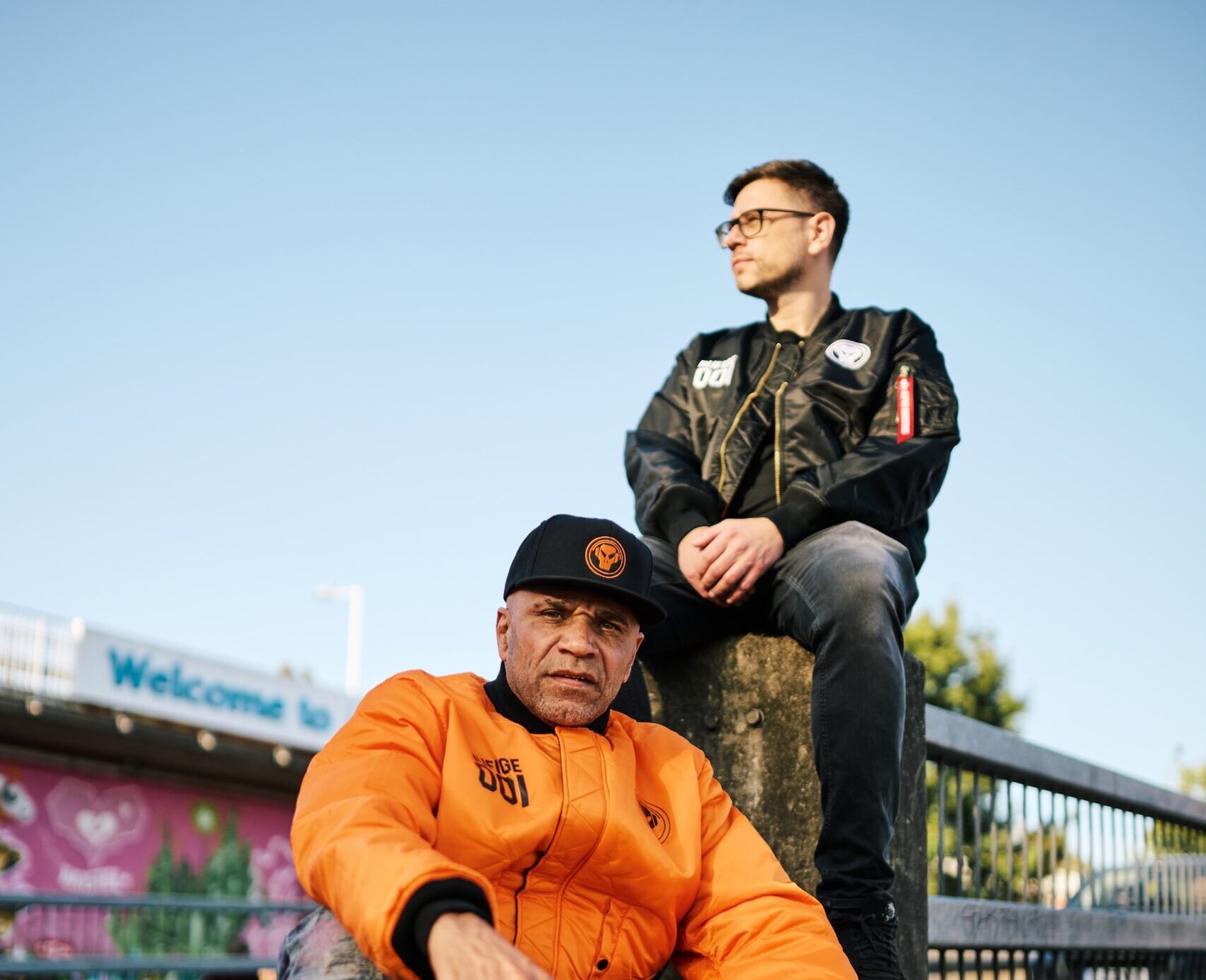
The mould of a timeless artist is to constantly create whilst staying true to their passion and sound identity. One of the original soundboys of this entire game is Wolverhampton-born Clifford Price – better known around the world as Goldie. In the drum & bass-sphere, he’s undoubtedly considered as one of the most influential figures dating back from the early 90s all the way through to the present. Within jungle, drum & bass and breakbeat hardcore, you can guarantee his legendary status. As a remarkable, dynamic artist, his endeavours as a graffiti artist, actor and breakdancer gave him a perspective on arts and culture unparalleled in today’s world.
Last year saw his alternate alias Rufige Kru return with a stellar album that held back no punches. Originally, Rufige Kru was a collaborative project with producers such as Mark Rutherford and Linford Jones – which then evolved into Goldie working with different collaborators over the years including Heist and Submotive. This alias pushed hardcore rave music into a futuristic, deeper and darker sound embodying a broad sonic journey experience. As the 90s progressed, he found success on an unfathomable scale under his Goldie alias, with albums such as Timeless and Saturnz Return paving the way for the drum & bass scene to grow exponentially – inspiring the next wave of artists. Rufige Kru tracks like ‘Darkrider’, ‘Ghosts of my Life’ and ‘Terminator’ really pushed the early rave sounds of 1992 – developing the genre we know today.
Collaborating with the infamous Reinforced Records, this experimental sound carved by Goldie introduced a sound away from the brighter hardcore flavours. Moving through the generations into the 2000s ‘Malice in Wonderland’ and ‘Memoirs of an Afterlife’ are two seminal albums that led the way regarding the transitioning of a drum & bass palette that was acquiring emotional depth, gaining a more rough-and-ready grit whilst becoming cinematic and intelligent. The release of ‘Beachdrifta’ in 2001 was an especially key moment as it presented drum & bass fans with a refined version of this gloomy, eerie blueprint that blends a classic jungle style with hard-hitting, driving production. As head-honcho of heritage label Metalheadz, Goldie and his Rufige Kru identity still holds an immeasurable amount of influence on today’s scene.
In the summer of 2025 we were treated to a new Rufige Kru album Alpha Omega and it has been heralded as one of the best bodies of work the jungle scene has witnessed in recent history. Working closely with Submotive, last year’s album was formed through old DAT tapes and incomplete concepts from the 90s. The essence of Rufige Kru keeps consistent to its roots, but has undeniably evolved with the times – introducing a fresh, uplifting take on jungle sound design. Profound yet experimental, tracks like ‘Still the Same’, ‘Alpha Omega’ and ‘Sandcastles’ exquisitely epitomise the newfound elements created under the returning Rufige Kru name.
With a new documentary out, located in Thailand, called The Rufige Files which looks back on its history and impact on drum & bass and jungle culture, featuring the likes of Heist, Photek and dBridge, it was only right we caught up with Goldie -the man behind it all. Looking back at early Rufige beginnings, moving through golden eras of the genre and talking about the latest, groundbreaking album Alpha Omega.
I’d love to know a bit about the influence behind Rufige Kru.
These days, the source of how people get their music tends to be less sample based and it doesn’t feel like there’s genuine roots in it. Time-travelling around music of black origin is a hard thing to do – which many in the scene struggle to achieve. It’s important for me to be frank. Within production these days, getting a synth and plugging it in or getting breaks from a sample pack might make you a quick banger, but it won’t make you tunes that stand the test of time. The drum & bass scene isn’t the only culprit. Early Rufige Kru influences go way beyond the demographic of drum & bass. You can look at any first generation hip-hop album that was sampling from their own genre of music at the time and that will give you an idea. They were the breaks that were around at the time. The go-tos like JayBee, The Meters, EPMD and Assembly Line, their particular type of breaks were so synonymous to the sound.
How did the Rufige Kru name come about?
We re-spelt it as Rufige from Ruffige. Kemistry said it’s like when you have porridge and the energy releases – it’s good for you. Also when you’re cooking with it, it bubbles to the surface – all the good stuff that nobody wants. That’s what Rufige stands for. The idea was whoever I worked with moving forward was always going to be part of a moving carousel. Whoever’s going to work with me and my manic personality was going to be part of Rufige. All the engineers and producers I worked with had to adhere to that Rufige sound.
Did that evolve with the scene over time?
Definitely. There was a turning point where you had the kung fu movie influence of Wu Tang taking loops that weren’t necessarily on the straight road – they were off the beaten track. There was more defined raw hip-hop that came out that had a grittier feel. You could compare it to sampling gritty jungle records from the 90s. Looking at the bigger picture of that you’ve got people like Roots and De La Soul who start expanding that sound outside the breaks we had inside the hood. They started sampling Janice Joplin and The Eagles which was a mad thing to us at the time. There were crazy rock loops and metal folk music being sampled. It became more of a global standard of sampling. For the people who were into that you’d be in awe of someone using a Steve Miller Band sampling in their track. And that’s where the creativeness came in.
Early Rufige set the precedent!
Exactly. We went for the classics, when you go beyond, especially with my work with Reinforced Records, as a camp we were synonymous with taking those classic breaks on a 16-track desk and actually putting them up, EQing them and then bouncing them back to a DAT. Then taking that DAT and putting it through two channels so all those breaks are mashed up into one break combining with another channel of breaks. This meant we freed up all these channels to then reinterpret the break. With Reinforced and early Rufige Kru, if you look at the layers of some of that early stuff, especially primary source underground software, it’s layered as a mismatch of breaks. The roughness of that, what we knew it as back then ‘the 16-track ting’. Or ‘the hithers’ as me and Grooverider used to call it. Because they’re based on early loops that are raw – from the likes of Warrington the Snowman which was on Kikman Records.
I’d say Rufige is a sound fit for proper jungle heads.
For sure. People gravitate towards these sounds because of the roughness and the rawness of the breaks. The difference jungle holds is that it leans into ragga, it leans into rare groove and funk, the darkside, even film samples. It’s all part of the tree. Rufige was about that from the very start. Look at the ‘Dark Rider EP’, ‘Jim Skreech’ or ‘Menace’. They’re all taken from different aspects of that one thing. The difference between this latest Rufige Kru album is that I took drummers who grew up on it, and understood the tunes, in Adam Betts and John Blease. We repatterned the classic breaks again to make them even more powerful – sprinkling the originals back on top.
Would you say the new album really stands by the ethos of early Rufige?
Editors in bedrooms and kids on a mouse reinvented how drummers approach breaks. That’s the ethos Rufige is all about. Pushing the envelope to what the sound used to be. Early Rufige will always be early Rufige. But what Alpha Omega is as an album stands there to prove a point. Take away the vocals, take away the shiny toys and let’s just listen to the breakbeat and editing aspect of it all. I’m really happy with this project as I believe it stands alone. I’ve been in this game for 30 years, Rufige and a handful of others invented this sound.
How did you achieve this groundbreaking new sound within the album, whilst keeping the essence of Rufige?
I had Dan Nichols on percussion, John Blease and Adam Betts on drums. This was in three different rooms with overheads playing a world of breaks – to then sample and process to create our own sound. For me, it’s all about organically creating your own and paying homage to the classics.
Who was flying the flag for original jungle back in the 90s?
People like Dego, Mark Mac and Shy. Ron was making some moves back then. Ibiza Records and Absolute 2 Records were prominent. Doc Scott was doing his thing. SS and his Formation Records as well. But without doubt, the pillars of this sound were Production House, Reinforced and Moving Shadow.
It’s a real credit that you’re still in this game and evolving 3 decades on!
I have a passion for this music and I still believe that there’s a big group of people who love this music. I want to serve the music that served me to where I am today. I think there’s a lot of nonsense these days surrounding the scene. Which I have no time for. Eventually all that noise will go away because there’s no place for it in this space. All that focus on doing big numbers and who’s played where makes no difference when you’re in the intimate clubs listening to the music. I believe in the Doc Scotts, dBridges and the Fractures of this world. You’ve got the great underground clubs and promoters still doing the business like Rupture. Big up anyone still making noise in the underground. We are the resistance. Blue Note set the model of labels having their own nights – creating that catalyst.
How did the release of this Rufige album make you feel?
I’m 60 years old. I knew after making my first record at 26 that I’d be making this music long after the critics had left. People have always criticized this music. I’ve known that my job isn’t a job, it’s an art form. People have come and gone and made nice business from this genre without making great stuff that stays true to the artform. I think you can hear my sheer passion for the genre within Alpha Omega, from cover to cover. It’s a powerful album, it’s layered and straight to the point. Everyone’s got their favourite on there. If you’re into editing and into breakbeat this one’s for you. There’s a lot going on in that album. Good music is a journey. Both my Goldie and Rufige aliases provide third gear bangers. You’ve got Bruce Wayne in the form of my Goldie stuff and Batman is my Rufige stuff. They’re one and the same.
There’s now a fascinating documentary out about Rufige. Tell me a bit about that.
Yes, we’ve made a Rufige documentary in Thailand. A beautiful piece. It focuses on the ethos of Rufige and what it really means. All that Rufige that’s left on the surface that nobody wants. That’s what this culture’s about. No one cared about this culture at the beginning. I’ve got about 270 hours of footage. Going back to me sitting in a flat with A Guy Called Gerald looking like we were 15 years old, talking about how we’re going to change the face of music. Because at that time there was nothing like this music knocking around. And there’s been nothing like this music since punk. A genre that lasted so little time because the media killed it. I hope this documentary can show that you can find yourself looking into different styles of the genre and different types of events, but you’ll always come back to the source. I really believe Rufige is the nuts and bolts of this whole game.
Through the scope of an artist this alias really highlights your creativity as a producer.
I’m a graffiti writer. I paint in colour. Using layers. Rufige is about understanding. As the documentary begins, you start with the outline. You work your way back in the layers. You turn it on its side. The lighter layers become lighter and lighter. They become darker and darker and darker. Till you get your final outline. There’s your piece. That’s what Rufige is. That’s what Tats Cru is. That’s beautiful. Being in a crew is just better. It brings more style. At Reinforced we were a crew. Tats Cru is a crew. That’s what I wanted to bring to Rufige. It’s that b-boy mentality that makes this what it is.
A word on Metalheadz and how its legacy is still holding strong today.
That mural in Bristol sums up the whole story of Metalheadz. All the influences like the yellow brick road and the clubs. It’s great to know that history. I knew the Goldie projects would go the whole way globally. I knew my job was to open doors and kick them in. And for the rest of the boys to follow through. It was a very conscious decision. It’s why ‘Platinum Breakz’ existed. We put that out as a big statement within the scene. That album is very symbolic. Time has been my biggest facet. I never felt we needed to quickly make anything. I believe that’s why Metalheadz and my production stand the test of time. There’s tunes I can play from the label and these younger kids won’t know when it was made. And that goes to show you how timeless it all is. Metalheadz isn’t a label. It’s an ideal. We became the motown of this scene. We’ve got the old testament and the new testament. That’s what Metalheadz is. You can go to an old school Metalheadz night and hear the old testament. And you can go to a current Metalheadz night and hear the new testament. If you understand the language of this genre, you understand it as poetry. Whether it’s Skibadee or Shabba spitting on the mic or whether it’s the newer guys on production like DRS. We’ve all got voices for this sound. It all fits in a beautiful place.
With great Metalheadz nights still going strong, it’d be great to have more of that injected into the rave scene today.
In this scene you’ve got to let people find their way around it. Without putting a wall up. The last time I checked, culture doesn’t grow at festivals. It grows in the clubs. It brings longevity. The necessity for these spaces are more important than ever now the clubs are shutting. Being able to hear how DJs go about their mixes, week in week out, is so valuable. I know there’s tribes we’ve created that will continue on with this great music. When you look at old jungle raving videos from back in the day, people are going nuts. Without phones. You do get it at places like Rupture or Critical nights. The last thing we did at Centrepoint was unbelievable. We had the old heads and the new heads. Myself and Photek played and we went to town on it. Look at places like Newcastle where we’ve had some great nights over the years and you just see people going for it. The club scene might be showing signs of a dying artform but I really do believe the new generation will ultimately bring it through. We’ve got to continue this alliance.
Looking at the 90’s rave scene, with nights like Rage at Heaven. How did that shape you in those early years?
It shaped me and a lot of others massively. It was so important. You’d go out on a Thursday and hear Fabio & Grooverider doing their thing. Seeing different ideas in the mix on a regular basis was so inspiring. This is what’s missing today. I don’t really hear the blending of dynamic styles these days anymore. Sounds that you wouldn’t think would work together but do. That inspires you as the listener to go and make another tune. I heard the boys bring in my ‘Terminator’ track with Doc Scott’s ‘Dark Angel’. All of a sudden ‘Terminator’ was no longer my track and ‘Dark Angel’ was no longer Scotty’s. It became this hybrid sound which gave me an idea and then I’d run into the studio to lay down another tune. The euphoria of the whole club completely having it off, with no phones, was just something else altogether. Creating continuity and longevity is what made those years so important and special.