
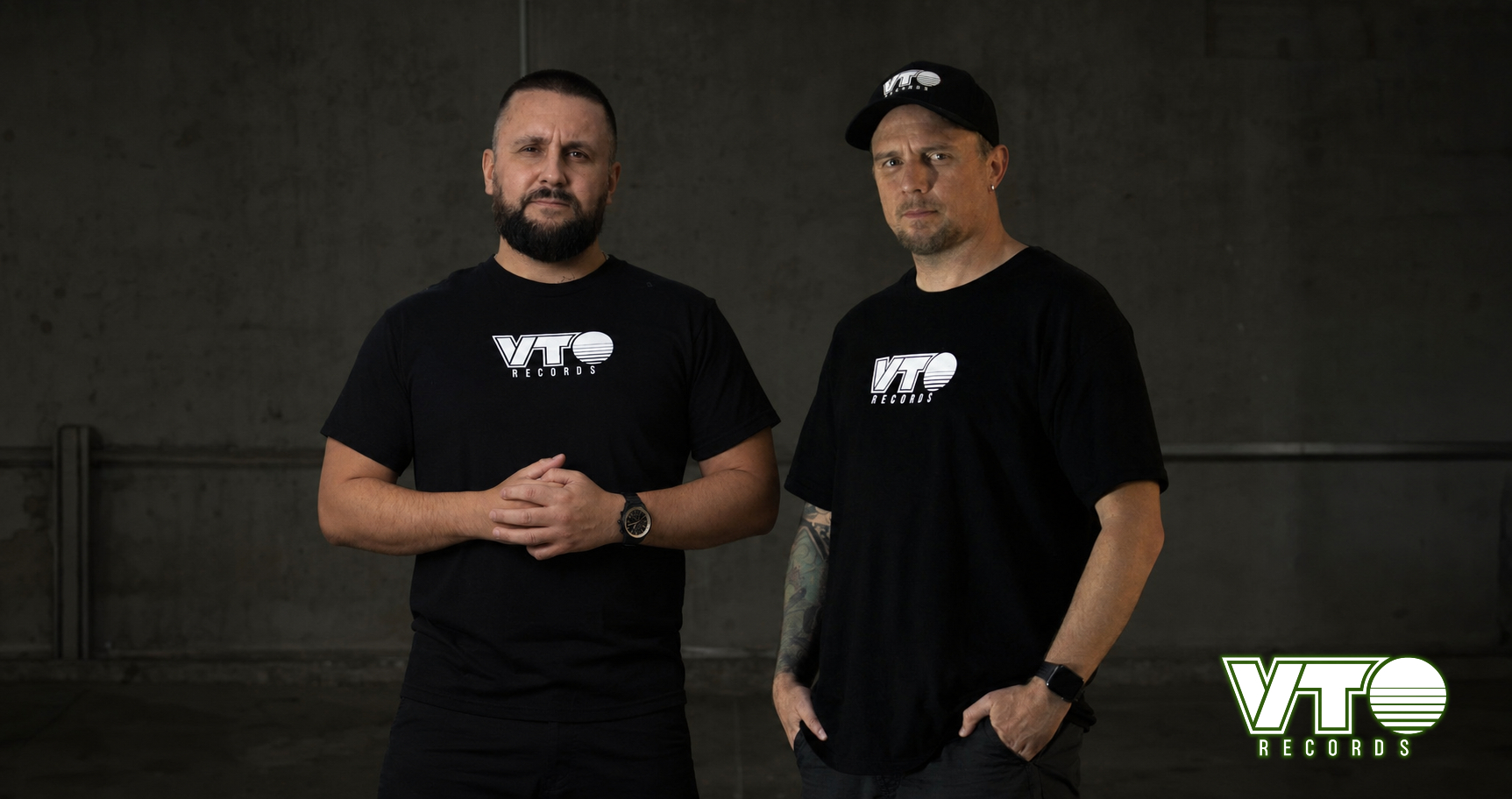
Five years. Somehow that’s both no time at all and absolutely ages in drum & bass. Long enough to survive a global pandemic, thirty-odd releases, six compilations and countless late nights in the studio. Not quite long enough to stop asking yourself, “What on earth have we got ourselves into?” Founded in 2020 by TRCD and Lee UHF, VTO has spent the last half decade quietly becoming one of neurofunk’s most dependable homes, championing artists from every corner of the globe while refusing to water down the sound that sits at its core.
Neurofunk; drum & bass’s slightly awkward younger sibling. The one that’s technically brilliant, occasionally misunderstood and somehow still doesn’t get invited to every party in the UK. Head over to mainland Europe, though, and it’s a completely different story. Clubs back it. Crowds live for it. You might even find yourself ordering a drink while neurofunk rattles the speakers in the background. Here in the UK? It’s a little more complicated. But if chatting to TRCD and Lee UHF proves anything, it’s that challenge has never been much of a reason to slow down.
With VTO celebrating its fifth birthday through its new compilation A New Beginning and its first dedicated label event, I caught up with the pair to look back on where it all started, why neurofunk continues to thrive against the odds, and where they hope the next five years will take both the label and the wider scene.
Hi, how are you?
Lee UHF: Good. Thank you. Enduring the heat.
What have you been up to recently?
TRCD: I’m actually in the studio at the moment trying to finish off a remix.
Oh, sick. How’s it going?
TRCD: All right. But yeah, on the clock. This is my ear break.
Lee UHF: I’m on his case at the minute trying to get him to finish it.
Congratulations on the five year anniversary. How do you feel?
Lee UHF: It’s been a long time. Feels like 10 years if I’m honest. A lot of work.
TRCD: It feels like a long time, but at the same time, it’s gone quickly.
Lee UHF: Just a lot of releases. This will be our sixth compilation and our 37th release as well. Once this comes out. So, we’re well over 40 releases in five years.
Let’s go back to the very beginning. Why did you start the label and how did it come about?
TRCD:
It was during COVID. No one really knew what everyone was doing at that point in time and Lee started Dirtbox and asked me to do some tracks for the label. At the time I personally didn’t think they were suited for Dirtbox for what they were releasing at the beginning of the label.
Now he puts neuro on there and everything. But at the time it wasn’t so much neuro. So we had this idea to start a label. Originally it was just to churn out some stuff from me and then we’ll try and get some artists involved once we start getting the ball rolling.
Lee UHF: We both had a lot of experience in the past running our own labels in other genres and with me doing Dirtbox and Dan providing tracks for that early on. It was almost inevitable that we’d end up doing something together.
Dirtbox is a multi- genre label. I run on my own and we wanted to do something that was focused on the very intricate neurofunk sound in terms of what we put out.
What do you think is special about the neurofunk subgenre?
Lee UHF: I think personally it’s like the bastard child of drum and bass. It always gets the last look in. But it gets the most respect when you look at it from an insider point of view. It’s the hardest music to make on the planet. There’s no other genre of music that is harder than neurofunk to make and make well.You generally find the level of producers is exceptional. Look at people like NOISIA who championed it. That’s the level everybody’s trying to reach.
Neurofunk is huge in the USA and mainland Europe, but it’s not the most popular subgenre in the UK, how does it affect your workflow as a UK based label?
Lee UHF: It’s easy from an A&R standpoint because of the internet. You end up joining communities and speaking to people and it flourishes that way. We have producers sending us music from all over the world from the Ukraine, from Australia, New Zealand, Europe. Everywhere.
From a gig point of view it’s hard to push the sound in a club in the UK because it generally still to this day doesn’t get a massive look in. The bigger festivals don’t really concentrate on it. You get the odd AMC set which plays a bit of neuro, a bit of crossover stuff and jump up, but as a whole it’s harder to push on a physical level in the clubs.
But as a label we have no problem. Our biggest sales come from America, Germany, and most of Europe really.
TRCD: I think with the UK scene there’s just not enough clubs catering for the sound. When you look at all the other sub genres of the drum and bass, they’re all catered for, but neurofunk isn’t. It’s a risky genre to put an event on, there’s a few events in the UK that do try, but when you speak to them, they sound like they’re worried in a way, but they’re still trying. There’s not enough people who want to basically put their hand up and say, “I’m going to do it.”
Do you think it’s the financial risk?
TRCD: It’s a lot of the clubs as well, their fees are so high and you’ve got to try and cover all those margins and that’s what puts the risk factor into it. You want to get a headliner in but you can’t afford it because some of the bigger clubs are probably charging a lot, but you know they’re all trying to survive as well. So it’s just the UK scene. I think that’s the reason why you don’t get as many neurofunk events popping up in the UK.
Lee UHF: Yeah, it’s a common thing with clubbing in the UK at the minute. There is a big problem. But then when you’re dealing with a small section of music like drum and bass that’s probably not as popular as jump up and rollers and things like that, then obviously that creates an even smaller aspect of it as well. So it’s even harder to get people out.
Why do you think it’s so popular in other regions?
TRCD: I think it’s the clubs. If you go to the Czech Republic the clubs back that music so they with work the promoters more to bring DJs over and stuff, a couple of years ago most of my gigs were abroad. I didn’t have any in the UK whatsoever.
I got a few this year in the UK, but most of them are abroad. And I don’t know for a fact but maybe the clubs aren’t charging as much to hire. I mean there’s a club I’m not going to mention the name of but we were looking to put an event on but with the hire fee alone you just you just can’t do it.
You can’t justify the budget of the hire fee of the club and then you got to book headliners, then you’ve got to try and get those people through the door after all that you’re lucky to break even.
Lee UHF: It’s the culture as well, isn’t it? I think with European culture harder style music is ingrained into the day to day a bit more. You go to Holland and from the late 80s they had hard techno and gabber in the national charts, so they’re a lot more used to it.
But also, you can go into a cocktail bar and they’re playing neurofunk. I’ve been in bars and restaurants in Poland and Czech Republic and they’ve actually got neurofunk drum and bass on. It’s more of a way of life.
You both work in drum and bass outside of the label. What’s your background in D&B ?
TRCD: I started my music career in a record shop called Dance2 in Guilford. I worked there with Ed Optiv and he introduced me to drum and bass. So that kind of started my path.
I didn’t make drum bass at that time, but I had the records to take home. I’ve just always had an interest in drum bass from that point in time. I couldn’t get my head around how to make it because I was obviously working with Ed and he was a scientist I was never at that level.
It always seemed like really hard music to make. It is probably the hardest music to make. So as time went by, I made other genres of music and then slowly worked my way back around to understanding drum & bass. Back then it was inside knowledge, apart from things like AIM and Dogs On Acid where you can get tips, but apart from that, it was all a little bit of a kept secret.
And eventually things started opening up. People put stuff on YouTube and now there’s millions of tutorials on how to make drum and bass. Everyone’s got that access to that now. And that’s why there’s so many artists popping up now. Which is great.
I started dabbling in making D&B in about 2012, and then in 2014 I had my first release on Cymbolism Records, which is a US label. I started building up to different labels from there. Being friends of Optiv and CZA I started sending them music and they signed some bits up.
Ed signed a couple of tracks first for his label Red Light that put me into the scene. After that I then started doing some other bits for Cause4Concern, some tracks for Trendkill which is Prolix’s label, Eat Brain, Blackout, Neuroheadz, Evolution Chamber, lots of different labels I just started building my way up. I’ve never ever stuck with a label and just stayed with them. I’m going to basically just work with labels, affilliating myself with some labels, constantly working with them but never exclusive.
In my opinion I don’t think artists should do that because it can stifle you because you can’t experiment when you’re signing exclusively to a label. Unless obviously they’re open to that but some labels just want a specific type of music that they’re going to put out.
And I’ve actually started doing more stuff with C4C as well, me and CZA have started a thing called THRE3Ø3. We’re both into analog equipment and we’ve been trying to think of a name for ages.
He comes over and visits quite a lot when he’s got gigs in the UK and he’ll hang out with us. We started making some tracks and were going to go under the names CZA & TRCD. On the way back from a gig on New Year’s Eve he was just like “We got to think of a name!” We went through so many different names and then because we like analog equipment Mark suggested THRE3Ø3, named after the Roland TB 303.
I think he was joking. I was like, “Actually, that might work if we just play with the word.” I don’t know why we did the Norwegian zero – we’re just trying to find a logo we’re just like, “Oh, let’s just use that.”
It is separate from what I do as TRCD which is more normal, up-to-date neurofunk, whereas with THRE3Ø3. We’re focusing on the old style around 2010 up to 2015. I think a lot of people are missing that sound. So we’re trying to cater for that in the present day.
You’ve got a lot going on. How about you Lee UHF?
Lee UHF: Me and Dan have mirrored quite a lot of our careers really. I got into it in the late 90s and just like Dan, I started working in a record shop, but I’m from the other end of the country. I’m from Sheffield originally. I started working at a shop called Reflex Records. Back then I had built quite a successful career in hardcore, but more on the harder side, not happy hardcore, like your DJs Dougal & Vibes sound. It was a sound you called “Freeform”, and I guess in a way Freeform definitely has a lot of similarities to neurofunk. It’s the bastard child of a bigger genre. Its harder, darker and more techier than happy hardcore.
TRCD: That type of music is how me and Lee UHF actually met because we were both making that stuff at the time.
Lee UHF: Yeah, that’s it. Dan was releasing tracks. I just started producing and every time I had a track on an album like the bonkers compilations,, I’d see Dan’s name too and we just kind of got in touch that way. In the old way on MSM messenger and things like that.
I then started running events and labels back then too and during my honeymoon of music, and I created a bit of an empire with a brand called Bedlam. I put out vinyls of our releases and I was doing big monthly events called Total Bedlam where we were flying people in from abroad alongside massive names. Dan even came and did a live PA with his label.
As I started getting a little bit older I got a bit bored of the sound. It started going on a bit of a spiral like the clubland sound, and I kind of just drifted away in the mid naughties.
Come 2010, I was still releasing hardcore music as I had a back log of vinyls we had on a P&D deal, but I’d already started getting ingrained into drum and bass. Then after probably like four or five years of not talking to Dan, he gets in touch. He’s like, “Oh, I’m into drum and bass as well.” So again, just parallel moments.
I started putting on drum and bass events when I moved to Birmingham around 2008. But on the music side I’ve always had a love/hate relationship with production, I can have spats of time where I just don’t go near it and I just can’t deal with opening a DAW and starting tracks. So, at the time I was just enjoying drum and bass as a new sound to me.
I started a drum and bass band. (Dirtbox Live) We had a drummer, a live beatboxer and myself doing live sampling and DJing and it really took off. We were playing all around the world. I seem to get more gigs abroad than I ever have in the UK since doing DNB. I was flown across Europe, Australia, America, Asia and everywhere else with the band.
Had you moved over to drum and bass completely?
Lee UHF: Not totally as I liked a lot of sounds. I was also really into that Kill The Noise style of dubstep. It was like a bass house, kind of sound. And I was kind of doing gigs for that as well as drum and bass. It was like that for about five or six years, just a whirlwind of airports through that time. Towards the back end of 2018 the band split up due to it being hard to get five people in one place at one time all the time. A lot of the gigs towards the end were just me and the beatboxer or just me and the drummer because somebody didn’t turn up. It just became really hard to kind of manage.
That year. Dan had talked to me about releasing some of his tunes. So that’s how I put Dirtbox together as a label in 2018. The first time I was running a label it was vinyl and now I’m dealing with digital, so I had to learn it all over again.
The pandemic hit around 2020 and Dan came up with the concept to do something specifically on neuro funk, I came up with a name and that gave us the idea behind the theme and that’s how VTO was born/.
One thing over the last five years or so, I’ve just absolutely loved working with record producers and running the label. So, all of my production stuff took a backseat. Then last year, I started making music again, just literally out of the blue, my knowledge was not that good on drum and bass. I’m still kind of learning with it. But I’ve been writing tracks with an Argentinian producer called Noise Souls, and he’s given me a lot of help. He’s finished a lot of half finished projects that I had. And I’ve been releasing consistently every month now since December. I’m building myself back up now and I’ve got the itch again for making music.
I’ve actually got my first single on VTO too, on this album as well. I’ve got a few other big releases coming up on some pretty decent labels also.
I’ve also just announced that we are doing some VTO events. I’ve teamed up with a couple of guys (Dave, James & Andy) who have been interested in doing something, to kind of get some neuro funk in the UK. We’re not going crazy with these. I don’t fancy putting my mortgage on the line for an event. It’s it’s too much stress.
We’re just going to do some events as cheap as possible, some really good artists, only the artists on the label. Bringing in artists like that are just doing it for the love and the fun really. We’re going to make tickets super, super cheap so everybody can actually come and just have some more fun,
Where are you going to do it?
Lee UHF: It’ll be in Birmingham. I’ve got three clubs that I’ve regularly used for drum and bass nights over the years. Because I have been doing Dirtbox nights over the last 10 years as well. This will be our first VTO night to celebrate the five years. That’ll be on August 15 at the Rainbow in Birmingham. So it’s an iconic club as well, we’re really looking forward to it.
Let’s talk about the compilation…
Lee UHF: The whole project is called A New Beginning. July 17 and 24, there’ll be two album samplers, which will just have a few tracks from the compilation as a taster. And on July 31, part one and part two will come out of the album the same day. They’re a mixture of brand new tracks and remixes of some classics from the label.
We didn’t want to put another ‘best of’ out, we do a ‘best of’ every January. We just want to keep the focus on the new artists we signed and some of these big remixes that we’ve got done as well. There’s some really, really cool tracks, it’s definitely one of the best releases we’ve ever done.
We’re changing the theme of the artwork a little bit as well. The cyberpunk futuristic thing has run its course. We’re opening it up now, keeping it in that neuro aspect and the color scheme, but adding in a bit more Scifi horror elements, without going too overboard.
TRCD: Imagine a VHS case having the 80s sci-fi horror pictures. The kind of VHS video you’d see in the rental shops.
Lee UHF: The theme’s always been retro for us. That’s why we came up with cyberpunk. We both got a love for synth wave and that kind of stuff as well. We do want to keep a specific theme, but just open it up a bit so we don’t run out of ideas. There’s only so many times you can have a man walking down the street or a flying car. Do you know what I mean?
Sounds cool, tell us how did you choose which tracks to remix?
Lee UHF: We have a group chat with all the artists that’ve ever appeared on the label. So we basically put it out to them to offer remixes being done of their tracks and remixes they can do.
Did those artists get a kind of say in who remixed their tracks?
Lee UHF: Yeah. Absolutely. We got people obviously putting their name in the hat to remix and we got people wanting remixes. So, we just had a discussion with everybody that reached out.
A couple of people were just like, “Yeah, get it remixed. Go ahead.” But like 8 out of 10 times people said, “Oh, could I get this guy to go and remix it?”
You’ve got the compilation, are you doing anything else to celebrate?
Lee UHF: An event as mentioned. I mean, we’re not doing it to make any money at all, but if we get a good turnout for this, I’m definitely going to make it a regular thing. We’re flying in TR Tactics to headline it as well. And then the rest of the lineup will be people who are on the label like myself and Dan. We just signed a new artist to the label called Titanz from Essex who’s making a few waves. Syndicate from Germany So, they will be there as well, then of course The Fi5th, TheLena and Stonx who are regulars on our label.
It’s a big thing for us to celebrate this in a different way than what we usually would with a release. It’s doing the ultimate thing to promote a release. We’ve got some big artists already there. So MEL got her track remixed by TRCD. Stonx has got two tracks on there that have been remixed by Nemean who’s obviously just had some massive tunes on some massive labels like Blackout recently. Anzio has done another also. There are a ton of new artists appearing as well as old faces too. It’s the perfect release for us.
You get the impression in neuro funk that everyone kind of really loves each other and there’s like a real real sense of community and support…
Lee UHF: There’s politics like in anything. But I think if you’re somebody who seems to be political, because it’s such a kind of small side scene, it gets seen straight away. It gets called out and everybody knows. But for the most part we know we’re all in it together. We’re all a bit older and wiser nowadays. We’ve all got families and we’re all just all getting on with our own thing.
It would be good to have more of the bigger labels help up some of the smaller labels. But I think a lot of smaller labels now are smashing it just as big ones. They might not look like they’re not because they’re not doing events. They don’t have a stage at Let It Roll, but you look at labels like Stonx like he’s absolutely smashing it because he’s built a community through his Discord and his Twitch channel. His sales obviously must be matching labels like Blackout because he’s always at the top of the charts for his label.
Nowadays it’s about building community more. Especially with events suffering like they are.
Where do you see VTO in another five years for your 10th birthday?
Lee UHF: For me, I’d say I hope we are doing more, I hope we are doing events and that they’re successful. Me and Dan have chatted. The next big thing we’re going to push is to host stages and do more takeovers and stuff. Now, my kids are a little bit older, so I’m djing more again.
Me and Dan can obviously get the ball rolling on that because we’ve got so many good artists that deserve it. Like the ones featured on this album: TR Tactics, Mel, Stonx, FractalOne, TheLena, Nemean, The Fi5th, Diode, Bad Ace, Kaizen Flow, Roadboyz, Esym, Netsphere, Syndicate, Titanz, Anzio, Gravitape & Riege
Our great friend Jane Doe in Australia too- we’d love to be able to give all these guys some opportunities for being part of the label. That’s our goal.
TRCD: We want to be hosting on stages and to get some second rooms at some UK events would be good. I think if you have those opportunities, you get more artists coming over. No one’s making a million pounds from making a neuro funk tune at the moment. It’s great if you can have these kinds of opportunities for artists to entice them into releasing with you. From an artist perspective they’ll look at a label that’s not given them an opportunity then I’m talking from an artist perspective here. If I see a label that’s going to give me opportunities then I’m more inclined to work at that label.
It sounds a bit selfish but in a way that is me helping them to help me.
Lee UHF: That’s it. It always helps as well that me and Dan are actually making music and have some key releases out as well because we can use that to our advantage because they know there’s going to be quality behind this. Dan is a respected artist, I feel I’m a respected label manager now as well. I’ve worked with some big labels and continue to in the background.
Having access to the artists is really good, but like Dan said, we want to make sure they’re getting something for working with us as well. And creating those opportunities.
Follow VTO: Website / Facebook / Instagram