
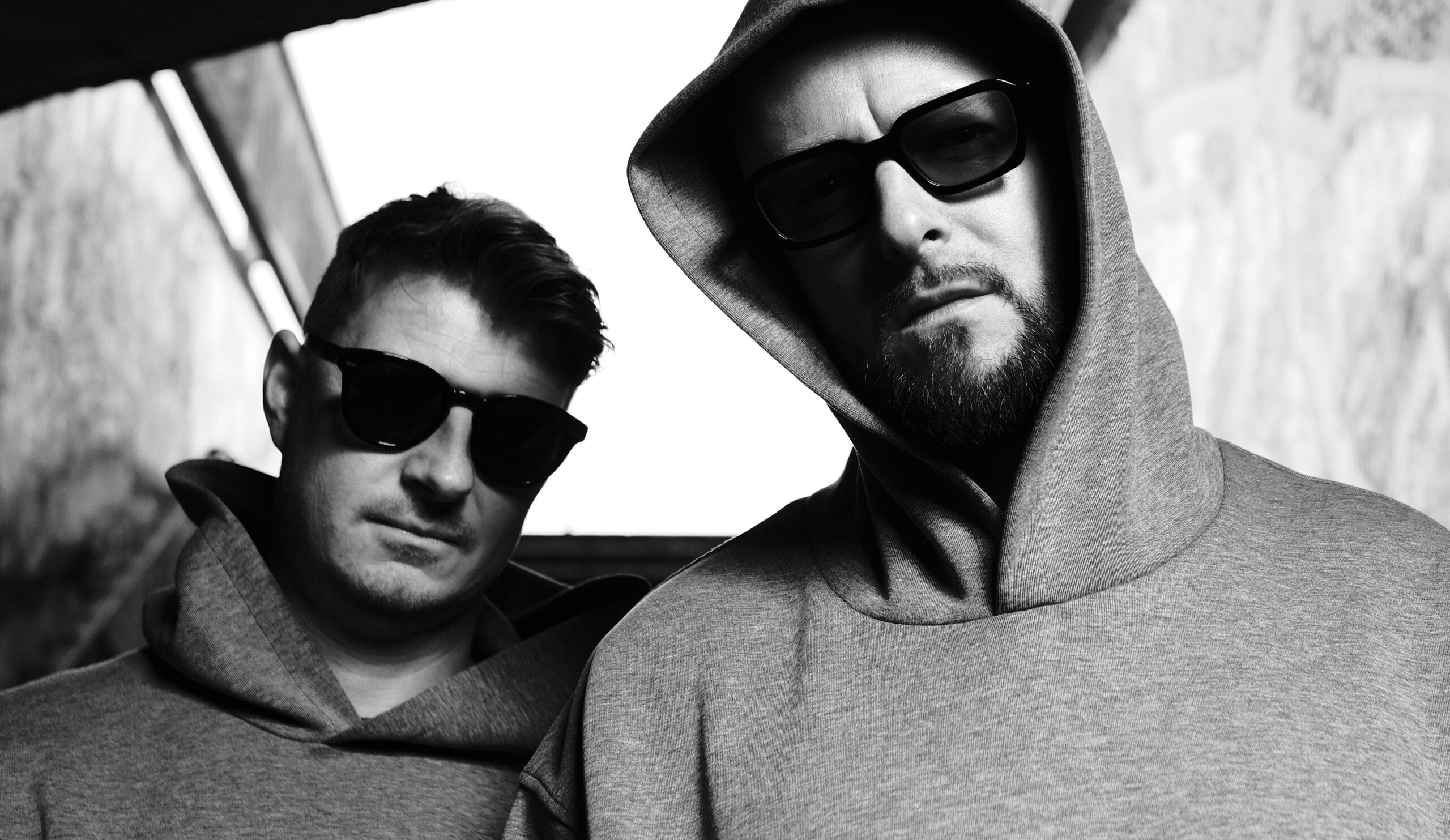
With a rich history of collaboration between the two artists, Addison Groove and Sam Binga have joined forces once again to put together a debut collaborative album that fuses a flurry of club sounds including chicago house, detroit techno, electro and juke – inspired by the Midwest, whilst hitting the faster 140 to 150 bpm mark. This being their first release together since the ‘BS3’ EP in 2013, this project has caught the attention of a wide range of artists on the electronic circuit. The pair based in Bristol are highly-respected in the UK underground scene for pushing genre boundaries rather than sticking to one sound. This album remains true to that philosophy, marking another eclectic body of work for the two producers. Their sonic fusions have been combined to create real, certified, tracks for the dancefloor.
‘BAGS INC’ channels relentless club energy through a series of adventurous, hardware-driven productions. Built around Addison Groove and Sam Binga’s shared passion for stripped-back, machine-led electronic music. 72 hours confined in Devon Analogue Studios and the raw sound board was created. The project was first tested on dancefloors at Outlook Origins Croatia 2025 before making a notable impression during the recent Pineapple Records fabric debut in April. Drawing inspiration from chicago box jams, detroit techno, acid house and electro, this album is shaped by an arsenal of classic drum machines, vintage analogue synthesizers and rare outboard effects.
Rather than easing listeners in, ‘FKN SRS’ launches the album at full throttle, combining infectious vocal snippets, bouncing rhythms and shimmering synth work into an immediate dancefloor weapon. The influence of classic chicago house is prominent, whilst the production still feels fresh and truly their own. The adventurous spirit continues with ‘TYP SHT’, where morphing filters and constantly evolving synth sequences create a more unpredictable, left-field atmosphere. That momentum carries naturally into ‘REDPOINT’, a stripped-back cut that relies on crisp percussion, warped electronic tones and understated grooves instead of sheer power.
Momentum ramps up again on ‘SACUDE’, featuring Mexican artist Sirius Soundz, as pounding drums and tightly wound percussion drive one of the album’s most intense moments. ‘FROM THE BACK’ nods to the playful energy of early Chicago dance music, reinterpreting it through deep sub-bass, electro textures and minimalist vocal sampling. By the time ‘HIT THE MOOSE’ arrives, the album reaches its most uncompromising point, layering jagged synth patterns, distorted vocal fragments and gritty analogue processing into a frenetic, high-impact finale. ‘SQZME’ leans into another club-focused track that firmly falls into peak-time territory, driven by weighty low-end pressure, gritty analogue textures and cleverly placed vocal snippets that give the track an infectious sense of movement. Its rolling groove and tactile sound design make it one of the album’s most intense dancefloor moments.
Having performed a momentous live Fabric set, introducing their new live set up, as well as a live all-night long follow up show in Bristol. The momentum these two renowned artists have built with each other is undeniable. Now that the ‘BAGS INC.’ project has been so well received amongst fans and musical peers alike, we thought we’d catch up with the pair and dig deeper into their shared dynamism over the years.
What were you guys listening to back when you first started out as budding producers?
Sam Binga: It does depend how far back you want to go. I’d say early jungle and techno stuff got me into dance music. For example, I remember the first time I heard ‘Valley of the Shadows’ by Origin Unknown on the radio. From when me and Tony started working together in 2012, there was this big footwork explosion that happened. I remember there being this one mix called the Bare Bones Big Juke mix that had a bunch of classics. There was this one insane cut up of The Titanic theme song. It was all crazy and like nothing I’d ever heard before. At that point, I was starting to do more of the halftime stuff with people like Om Unit and Fracture. It was a new way to do uptempo, fast, music. I think stuff like drum & bass can have the tendency to be very production focused whereas footwork felt like you could rely on the vibe more with samples. It was a real breath of fresh air.
Addison Groove: I was into my dubstep. At the time I was using my dubstep alias Headhunter releasing on Tempa. It was a crazy time as I was just travelling around DJing as much as I could. At around the 2009 mark when I first started listening to footwork, it was around the same time as when the dubstep scene started feeling a bit weird. The word ‘dub’ didn’t feel like it was a part of it anymore. At that point, the 130 stuff started to come through, you had tunes like ‘Hyph Mngo’ by Joy Orbison and eclectic producers like Julio Bashmore. I just wanted to make a tune that could bridge between dubstep and footwork. I ended up creating ‘Footcrab’, a year later Pinch and Pervarlist were telling me this was the best thing I’d ever made.That got released on Swamp 81 a label I ended up releasing a bit more on over the years. This was the transition between the genres for me, which also coincided with when I met Sam, so we decided to start making tunes together. We were both into the 160s a lot.
Can you remember what the first thing you put out together was?
Sam Binga: It would’ve been the BS3 EP in 2013. We then did an album together on the same label. Fun fact about the first record we put out, the week before I was due to come round and start working on it the pedal snapped on my BMX when I was riding to the studio and I broke my collarbone. It ended up being very memorable. Another memorable time was with the track ‘Rzor’, I had some bongos that I recorded in my studio where we just made it go up for 8 bars, making it go up to 127 on MIDI. At the time we were essentially just messing around with things and finding out what the result was.
Addison Groove: It all came together quite quickly really. The music was fresh and we felt it was a new take on electronic music. Our production techniques are quite unique so it was a great fusion of sounds. For a long time I’d be using stuff like rewire. I’d be using logic and ableton at the same time. Sam can confirm how confusing that is as someone who has worked with me. But our different influences definitely built for more innovative tracks. Chopping vocals in ableton, making drums from scratch – it was all part of a process.
Do you remember when you first met?
Addison Groove: The first time we properly spoke would’ve probably been Dubloaded, a night run by Pinch from Tectonic. That was a weekly Wednesday night in Bristol at The Crofters.
Sam Binga: Yeah, it was a community night and only a fiver to get in. But It’s hard to say because we were both out in Bristol a lot. We both met a lot of people on this weekly night. I met Om Unit for the first time there too. The first time we met definitely would’ve been a night out we had in Bristol, well over ten years ago. It might’ve even been at this Spinn and Rashad night.
Do your styles work well together?
Sam Binga: I’m a big fan of making your own sounds from scratch, whether that be recording finger clicking or vocal chopping. Just experimenting and finding out what we can create is an exciting thing to do. I think we both do that really well. At the time we met it was an interesting time for the scene, footwork was doing its thing and we both had a mutual respect of what each other was doing – so we found a lot of common ground.
Addison Groove: 100%. I think that’s why me and Sam work so well together. I do accept I’m hard to work with as I have my own methods. But our shared love of certain sounds and ways of creating gives us a synergy when working together. A lot of the stuff we both did used 808s, the drum palette between us was already set in place.
Let’s talk about the album. How did you both find creating it?
Sam Binga: With the album, I had a bit of money in the Pineapple account. We’d just come out of lockdown and I thought we should do something fun. We started all the tracks down at Devon Analogue Studios. An amazing studio, in the middle of nowhere – in deepest, darkest Exmoor. It’s got every bit of kit you’d ever want. We went down there for 3 days, created a load of ideas and sketches, and then chipped away at them over the next few years. Only after the 3 days did we think the ideas we put together could work well as an album. As time went on we gained an understanding. I knew if a track was more Tony’s to finish, and I’d go away to my studio and finish off another one because I felt I knew where to go with it. When you find the right vibe when working with people it’s really easy to collaborate.
Addison Groove: We both love hardware so Devon Analogue Studios was the perfect place. It was mid-February so it was dark and cold, perfect to just shut away in the studio and work day and night. No sound restrictions and open at all times. We said we weren’t going to make a tune whilst we were down there, the purpose was just to create a load of sketches. We got about 11 or 12 ideas ready on Logic so we could go home, chop up and repurpose. It took a while to get this done, but that was what was so nice about it, there was never a rush to get it finished.
What was the early inspiration behind the project?
Sam Binga: We wanted to do something high tempo that wasn’t drum & bass or footwork. Hitech Detroit was bubbling around that time. We’ve both been fans of DJ Godfather and DJ Slugo, we wanted to dive into the ghettotech and ghetto house sound a lot more with this project.
Addison Groove: We started our tracks between 140bpm to 155bpm. A lot of synth tweaking was going on. Just a real push for uptempo beats that kept a gritty essence.
The combination of influences to create this raw uptempo project is clear to see.
Sam Binga: There’s always been a hunger for uptempo music. This project felt like a natural evolution for a lot of our influences. The Dance Mania stuff, as well as a lot of the DJ Godfather stuff. You’ve got Chicago Juke and Detroit Jit that we’ve really loved. All those raw, uptempo, bouncy tunes. We’ve had some great feedback from a wide range of DJs. From artists like Bakey, Sherelle, Leonce, DJ Heather, Fracture, Pariah, Barker and Hodge – such a range of different genres covered by these artists.
Addison Groove: All the tunes I’ve produced over the years are an accumulation of a number of genres that I’ve been inspired by. I get a lot of different types of bookings, the great thing about this album is that I can always draw for some of them in a lot of different types of sets I’ll play over the year.
Are there any cool stories behind any of the tracks?
Sam Binga: The final ambient track was a fun one because that was a drunken 4am session everything into everywhere else – absolute madness. It actually has a physical spring reverb in it, the idea is you put sound through it and it bounces up and down through the spring and it creates chaos. That was a lot of fun. A friend of ours, Sirius Soundz from Mexico jumped on one of our tracks, he gave us a voice note. I think that’s just the beautiful thing about building networks around the world. You can have someone from a different part of the world contribute to your art. He’s also a graphic designer so he ended up doing the layout for our graphic work for the album too.
Addison Groove: We’ve also got a video coming out with him. Showing a day in the life of him in Salamanca. It’s a really wicked video. The vocalist from ‘Squeeze Me’ is someone pretty big. We tried to use the recording on something else but it didn’t quite work, but it kind of opened the door to making ‘SQZ ME’ work so well.
Let’s talk about the Fabric room 2 takeover where you both played a live set.
Addison Groove: I’d already had some experience playing live after my first album that went out on 50Weapons. I toured around America with my 808’s. This was around 2014. It wasn’t really the same as today though. This time around worked out great though. Once we MIDIed it up everything was fine. The experience was really new for us in room 2, we were checking in on what kept the crowd in and what didn’t. A real learning experience. We had no idea how it was going to sound live, but we were pretty confident the TR 1000s would sound very good. I’d also used my 808s in room 1 Fabric many years ago which sounded great too.
Sam Binga: It was incredibly stressful. I’d never done a live set before, but I did have a clear vision of what it needed to look like. I wanted actual drum machines, I wanted synths and everything to be synced up. Essentially just being able to jam out live on stage. Creating a raw experience, and I accept, pretty much making it as difficult as possible for ourselves. It was also the first ever Pineapple night at Fabric so there was that extra layer of stress to deal with.
In terms of Pineapple Records getting a room 2 takeover, it must’ve been a real moment.
Sam Binga: Yes, without a doubt. I’ve got to shout out my manager Danny out in L.A, as he’s helped me push stuff and see the potential in a lot of this. It’s really exciting times and I can’t wait to see where we can go next. We’ve got a 3-way release with some major artists in the pipeline for the second half of the year.
Where can this live experience go?
Sam Binga: We actually did another live set not too long after in Bristol at a venue called Strange Brew and it was so much easier the second time round. We were more confident on what would sound good live. It was an all night long type of set over 6 hours so we managed to get through the genres. We started with some deep dub-techno and got into jacking out some 150. I definitely want to push and explore this live side of things more.
Addison Groove: We changed the set up a little so it suited our needs better. I’d say the second time round went better. Not to say the Fabric one was bad, as I really enjoyed that set too. We did have longer to play in Bristol so it gave us time to take the crowd on a journey. Starting on 140 with the intention to go up to 160 is a lot of fun. We can definitely do this more in the future and carry on refining it.
Are there people you take inspiration from doing live sets?
Addison Groove: Fjaak do it really well. I’m always curious as to how they do it and what they use.
Sam Binga: Seeing Jeff Mills back in the day with his 909. Watching him jam out seemed very exciting to me.
Do you see this evolving and becoming something you take further?
Sam Binga: I think so. I’ve set up a space in my studio with a lot of the live set kit. I think once I realised that by making the loops and ideas to play live, you’ve kind of already written the starting blocks for some new tracks. We want to see what direction the album goes in, but personally I think the whole package is very strong. I judge projects by seeing if it’ll be fun ongoing, and I think in this case it will be. I’d say the hardest thing about the live set preparation was that every bit of kit has an annoyingly slightly different way to save stuff. However, there’s definitely potential to do lots more as we get more in tune with it all.
Addison Groove: Exactly what Sam has said. After the Fabric set we realised we’d actually formed the beginnings of at least 4 new tracks. It’s one of the great things about playing live. It took 2 years to do the album but I’d say that was easy in comparison to the live set preparation we had to do. Each bit of kit had a different operating system so you’d have to learn about 5 different systems.
What are the summer plans looking like?
Addison Groove: I’m playing at Bass Coast first, then meeting Sam in San Francisco to go to play at Northern Nights festival. Then we are both doing Groove & Bass festival in Canada. I think I’ll be due a big sleep after all the travelling.
Sam Binga: I’ll be out performing in Japan before meeting Tony for those festivals. Then I’ll be at outlook in Croatia for yet another amazing year in Tisno.
As proper club DJs, I’d love to hear your top 3 clubs to play at?
Sam Binga: The Warehouse Project last year was wicked for sure. I love Strange Brew in Bristol too. Finally, I’ll shout out Fabric for taking the chance on the label night.
Addison Groove: I’d say Ormside Project in London was one of my favourites to play at. I’ll also say Strange Brew, it was perfect for what me and Sam needed on our live set. Hidden in Manchester also deserves a mention.
Who are some artists we should be keeping an eye out for?
Sam Binga: I’ll say firstly HLRTY, he does an interesting mix of electro and club music. He’s got great production and is definitely slept on. I think Sir Hiss is going to have a real moment, I’ve been working on some stuff with him, he’s got some unreal production. I’ve also got to big up Amy Kisnorbo, I’ve worked with her quite a bit – she’s been a key part of the Pineapple family too. I find her a very inspiring DJ. DJ Sprinter has also been putting out some cool stuff.
Addison Groove: One of my favourite producers at the moment is a guy called Identified Patient, he covers broken dub techno which I’m a big fan of. I’m also really feeling Black Rave Culture. Finally, I’d say Neida who mixes a bunch of 130 and 160 stuff.