
Detox Unit has released 27 songs, five projects, and played over 150 shows. He’s sat down for exactly zero interviews. Until now.
On August 21, 2026, Detox Unit released the Schematic EP (although fans were able to grab it a bit earlier through an exclusive Bandcamp drop). It’s been three years since his last official release, the ‘Liminal EP‘ and fans have been waiting patiently — and sometimes not so patiently — for new music from the Denver-based producer.
New Detox Unit music is a rare occurrence. It feels like a special event, which is a decidedly different approach than many artists take in the modern social media age. In an era where releasing a dozen tracks a year is standard practice to feed the social media algorithm properly, Detox Unit is an anomaly.
Despite a sparse release schedule, Detox Unit, whose real name is Joseph Roberts, has maintained his legacy throughout the last decade, cementing himself as a coveted festival act on stages ranging from underground bass music festivals like Secret Dreams and Sound Haven to AAA festivals like Electric Forest and North Coast. His reputation has deep ties to the Tipper community, which is the space that originally accepted him with open arms. To this day, Roberts credits Tipper as his favorite DJ of all time, and a mentor of sorts. In 2026, however, his impact has extended far beyond Tipper’s devoted fanbase.
He’s accomplished this while largely avoiding interviews, rushed releases, and the social media treadmill that defines so many modern artists’ careers for better or for worse.
In this exclusive interview with UKF, Roberts reveals his creative philosophy, why he rarely plans his DJ sets ahead of time, and his opinion on the ever-controversial “sync button” (which might surprise you, because it definitely surprised me). Roberts also gives us a full tour of his studio equipment: his essentials, his least practical purchases, and what he recommends for new producers.
Read on to discover Detox Unit’s favorite DJs, studio equipment, and what the future of Detox Unit holds.
You’ve been touring for over a decade, but you’ve never sat down for a proper interview. We’re honoured we’ve finally convinced you to have a conversation on the record… Why have you avoided interviews for your entire career?
The core of it is that my previous management had a very different approach to media. Interviews were not really a thing that was ever brought to me or suggested. For most of my career, my team had a sort of anti-social media agenda, which is a good and bad thing I guess. On one hand, it plays into this mystique and mystery about the project, which is cool and can create demand. On the other hand… dodging interviews wasn’t really intentional for me. I just thought that’s what I was supposed to do.
We’ve got a lot to talk about. It’s been three years since Detox Unit released the ‘Liminal EP’, and we haven’t seen any new Detox Music since. But this month, we’re finally getting some new tunes on the ‘Schematic EP’. A Detox Unit release feels like a rare, coveted occurrence. Do you have a specific philosophy around waiting years between releases?
For starters, I like making music for sound systems. But it takes some time to understand how a song sounds on a massive festival sound system. I’ll try it out on one system during festival season, and realize something didn’t sound the way I want it to, so I’ll go back to the studio and adjust. It’s a very meticulous process, but the end goal is to have the best possible sounding production no matter what system you hear it on.
Was that your philosophy for creating the ‘Schematic EP?‘
Yeah, I designed the Schematic EP to make your speakers sound good. I put a lot of time into mastering these tracks. I tested these tracks on massive sound systems for years, which helped me notice when a snare was too loud, or there was too much compression… things like that.
I’m also very inspired by underground music culture for the early 90s and 2000s. I want to bring that ethos into the current landscape of electronic music. These days, it seems like promoting the music is the primary focus, and how the music sounds takes a backseat. I don’t want to fall into that trap. The music will always come first for me. That’s why I don’t put out a dozen songs every year.
Do you ever feel that pressure though? To release music constantly in order to keep up with the rat race?
Of course. I definitely do feel those pressures, as I’m sure any artist does. Honestly, we’re living in a heyday for electronic music in terms of DJing, production, accessibility, and events. But I think sometimes the focus shifts away from the quality of music and toward the virality of music. I’m not knocking any artist that takes that approach, and I totally get why they do, but that’s not my primary focus. I’m always quality over quantity at the end of the day. I want to look back at my catalogue 25 years from now and be proud of every song I released from beginning to end. And you can’t really ‘unrelease’ a song.
That being said, I do want to get to a place where I’m releasing music more consistently. Three years in between releases is a huge gap, I get that. I’m actually working on a few more releases that will hopefully come out this year.
So then how do you find a balance between keeping up with your fans’ expectations and wants/needs, while staying true to your creative identity?
I try to spend less time in the comment section on social media, especially throughout the past year. Some artists like to tease their music to fans and let them decide which track they release. One time, my friend Jade Cicada let his fans pick the name of a release. The name that won was “moist boy.” That track is awesome too, but I’m not sure that’s the name I would have chosen” he laughs.
I prefer to make those sort of creative choices myself. It feels more personal that way. But I do still get feedback from fans, just in a different way. I see how they react to tunes live. That’s the biggest indicator of a great track for me. When I’m at events, I try to hang out before or after the set, especially at festivals. So I’m always reading the room, both as a fan in the crowd, and as a performer on stage. This helps me gauge which tracks are hitting the hardest, and which tracks fans really want to hear. I’m always reading the crowd and taking mental notes of which songs get a big reaction, and which songs don’t.
That’s an interesting perspective. Do you also adjust what songs you’re playing in your sets based on how the crowd is reacting in real time? Or is this approach more for the music you release?
Absolutely. I feel like that’s part of the Detox Unit brand — no two sets are the same. I’m very invested in the art of deejaying. It’s a passion for me. I enjoy the challenge of playing a great set that’s not fully planned out before I go on stage. A lot of my set happens in the moment. I usually know where I want to start, and sometimes where I want to end, but everything in between is spontaneous.
So then how do you prepare for a set if you don’t know what you’re going to play?
Most of my ‘set prep’ isn’t actually preparing a set in terms of stringing songs together and working through transitions and all that stuff. For me, preparing for a set means spending two weeks making new music and digging for tunes on the internet. I don’t usually open Recordbox to organize music for a set until the morning I perform. When I’m on my way to the show, at the airport, in the green room or the hotel, that’s when I make my playlist for the set. I play roughly 40 tracks in a 60-minute set, but my playlist will usually have 60-70 songs. Over half my sets are usually original music I produced and often include a ton of unreleased music. I have a habit of revisiting finished songs, making remixes or VIPs, which I’m trying to do a bit less of because it makes me feel like I’m working on the same song over and over again. My therapist tells me that’s not great for me,” he laughs.
“But I don’t actually know what vibe I’m going to play for any given set until I arrive at the venue. Every venue is different, and every crowd is different. Sometimes I get to a venue and it’s really echoey, which means certain tracks with crazy layered sound design and mid-range won’t sound as good. But break beats and stripped back dubstep sound great in those spaces, so I’ll lean into that.
The crowd will also let you know what they want to hear if you pay attention. Sometimes I’ll play a drum and bass drop with no intention of creating a whole drum and bass section of my set, but if the crowd goes crazy, I’ll pull up my drum and bass playlist and let that rip for a little bit until the crowd seems like they’ve moved on. Having that flexibility as a DJ is so important.
It sounds like you have the same philosophy as a great jam band; letting the energy of each night dictate the set list.
Yeah I mean, a good DJ set is a back and forth between the audience and the DJ. The crowd is there to have a good time. I’m also there to have a good time. It’s a collaboration in a sense because if I was on stage playing tunes to no one, that wouldn’t be much of a party, you know? I started deejaying in 2014. I was 20 years old. I’ve always been fascinated how masterclass DJs like Carl Cox and Fatboy Slim rock a crowd. When a DJ can totally lock in with the dance floor, It’s really special. That’s super inspiring to me. I’d like to see more of that in the scene. I feel like it’s more common now for a DJ to create a set, whether they’re on a computer or decks, without much spontaneity or mixing. Those sets can be great too. I guess it’s just not necessarily my thing.
It feels like two completely different experiences. DJ culture has definitely evolved since the days of spinning vinyl. You’ve been deejaying for more than a decade at this point. What other ways have you seen DJ culture evolve throughout your career?
On one hand, there’s a lot more healthy room for experimental music. Not just dubstep and bass music either. Sometimes it feels like we’re experiencing a resurgence of 90s and early 2000s music culture. Warehouse parties are popular again, which I love. Deejaying at 4:00am in a sweaty warehouse is one of my favorite places to perform. I hope that part of the culture continues to thrive.
On the other hand, everything is much more internet-focused. Which can be tough for someone like me, because I don’t have a TikTok. I don’t really do videos. I would like to do more streams of me in the studio though, sort of like Deadmou5 used to do back in the day. That seems more authentic to me. It makes the audience a fly on the wall while I make music, which is cool. I feel like at some point, I will need to engage more with social media. I sound like an old man saying that, but I know it’s true.
In terms of how the music has evolved since I started the Detox Unit project in 2015, I think there’s much more focus on dance music, opposed to hyper-aggressive and dark electronic music. Right before COVID happened, circa 2019, there was a period that felt like everyone was trying to make the most aggressive or hardest beat possible. Not that you can’t dance to that sort of music, but it’s a completely different vibe than what’s popular today. At least from my perspective.
What about DJ technology? How has that evolved in the last decade?
Honestly, there hasn’t been any huge shifts in DJ technology recently, but I am curious what comes next. In the early 2000s, laptops changed the game. Digital audio workstations (DAWs) too. Before that, it was the invention of the CDJ that made a huge impact. Then the sync button was added to CDJs in 2012, but everyone said using that made you a ‘fake DJ.’ They said that about using a laptop in the 2000s too.
How do you feel about the sync button? I know it’s pretty divisive.
Some people think using the sync button takes away the creativity and makes things too easy. I don’t feel that way. I see it as a tool that frees up more time to do other creative things in my set.
I’ll use my “Decks n Fx” DJ Set I did with DEF in Miami in 2024. I’m doing something similar at Factory Town for the Hocus Pocus festival this year too. I bring a ton of effects boxes for these sets, which I can use more creatively if I don’t need to spend as much time beat matching. This allows me to do some crazy filter, delay, macro combo effect, and then loop the other track on the CDJ.
I guess the question is: do you think there’s a point where new technology and convenience takes away from the creative aspect of deejaying?
Not unless we get to the point where there’s a brain trip implanted in your head and you just control everything telepathically. That would be crazy.
That sounds kind of scary to me… on a lighter note though, let’s talk about the new Schematic EP. Does your approach to deejaying impact the way you created the songs for this new EP? And can you pinpoint any element of DJ culture in these new tracks?
I’m always thinking “how would this song sound in my set?” when I’m producing a new track. A lot of times, I’ll make a cool idea in Ableton, and immediately want to try it out on the CDJs. That was definitely the case for the Schematic EP.
“Detonator” is a great example. I made that song as an homage to the early-2000s intersection of hip-hop, breaks, and electronic music big drums, raw samples, and that really in-your-face energy. At the same time, the song is a DJ tool because it’s very stripped back in certain areas, which gives DJs room to layer vocals, scratch, or manipulate it in a set. I love making tracks that entertain the average listener but also sneak in little tricks through the sound design, arrangement, and transitions for DJs to play around with.
Another example is “Big mood”. I was spinning a CD from my collection on the CDJs (CDJ-2000s, because the CDJ-3000s can’t play CDs). I think it was Basement Music by Moodorama. There was one part of the first song on that album that really stuck out to me that day I started looping it on the decks, and that gave me the whole inspiration for “Big Mood”. It’s the looping vinyl sounding thing at the beginning of “Big Mood” that I sampled from Moodorama. Hence the name “Big Mood.”
Schematic has a very cohesive sound. “Big Mood” and “Detonator” may serve different purposes in terms of their energy, but there’s definitely a throughline here. What was your creative ethos when you were putting together Schematic?
Well I made the original idea for “Equidistant” in 2018. I forgot about that song for a long time, then in 2022 I was prepping for my sunrise set at Secret Dreams, and I came across “Equidistant” which was a perfect song for a sunrise set, so I started re-working the original idea for my set. I started the Ludacris flip (which is an exclusive Bandcamp track, kind of a bonus track for the EP), right after Covid. Most of the other songs I started in the last year.
I never really make music with the intention of fitting certain songs into an EP. I just make a bunch of music, and at some point, an idea or theme will start to come together that makes sense for the music I’ve been making. Recently, I’ve been on a break beat, retro futuristic, hip hop vibe. It’s old school, but with modern sound design. Once I made a few songs in that vein, I felt like I had a proper direction for an EP.
What about the name “Schematic”? What does this title mean in the context of this EP?
Cambridge Dictionary definition of “Schematic”: showing the main form and features of something, usually in the form of a drawing, in a way that helps people to understand it)
The Schematic EP is a blueprint of what I want to do going forward. It represents where the Detox Unit sound is right now — the ideas, influences, and production philosophy I want to keep exploring. That’s really what the title means to me. It’s a schematic of what this project can be; it’s a blueprint, and there’s so much more to build.
Follow Detox Unit: WEBSITE / FACEBOOK / SOUNDCLOUD
Detox Unit- Studio Tour
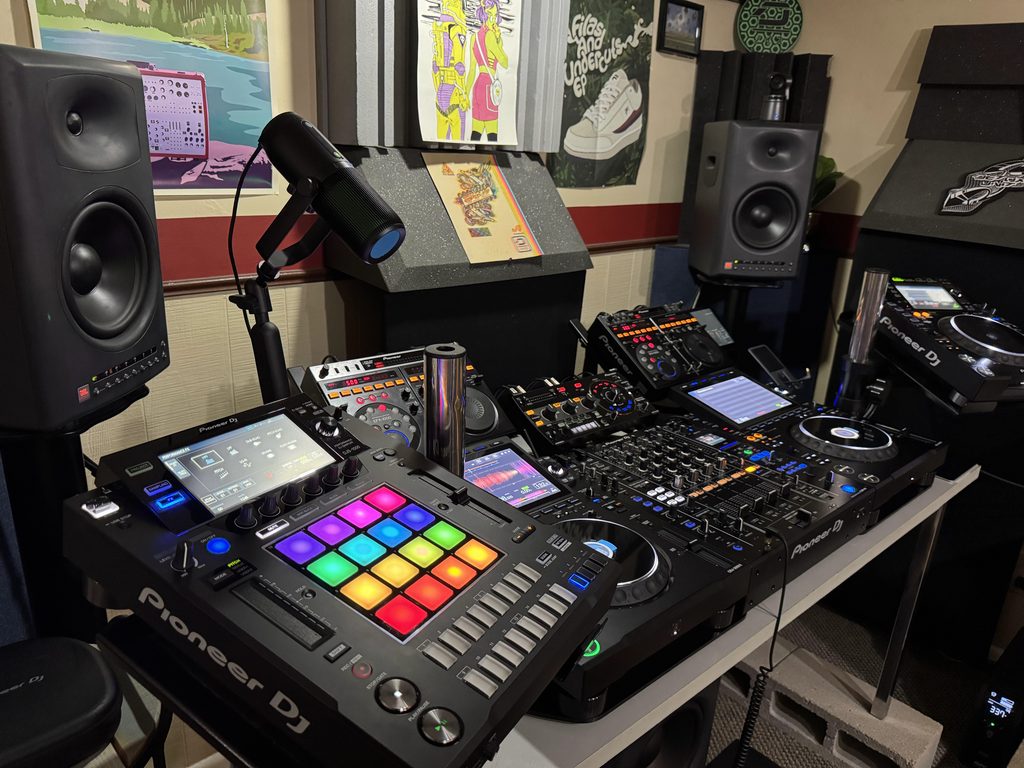
Detox Unit’s current DJ setup:
- CDJ 3000x’s + 2000 Nexus 2
What Joe recommends for someone getting into DJing:
- Used pair of the original CDJ 2000’s + 2 channel mixer of your choice.
Favorite piece of music production equipment:
- Access Virus TI 2
- Second: SSL Fusion
Biggest studio splurge:
- Speakers – Barefoot MicroMain26s – $13k
- Room correction box – “Trinnov NOVA” – $4k
One piece of gear he couldn’t live without:
- Studio cats… or TC Electronic Clarity (little screen that gives him all the info about the audio stats and songs)