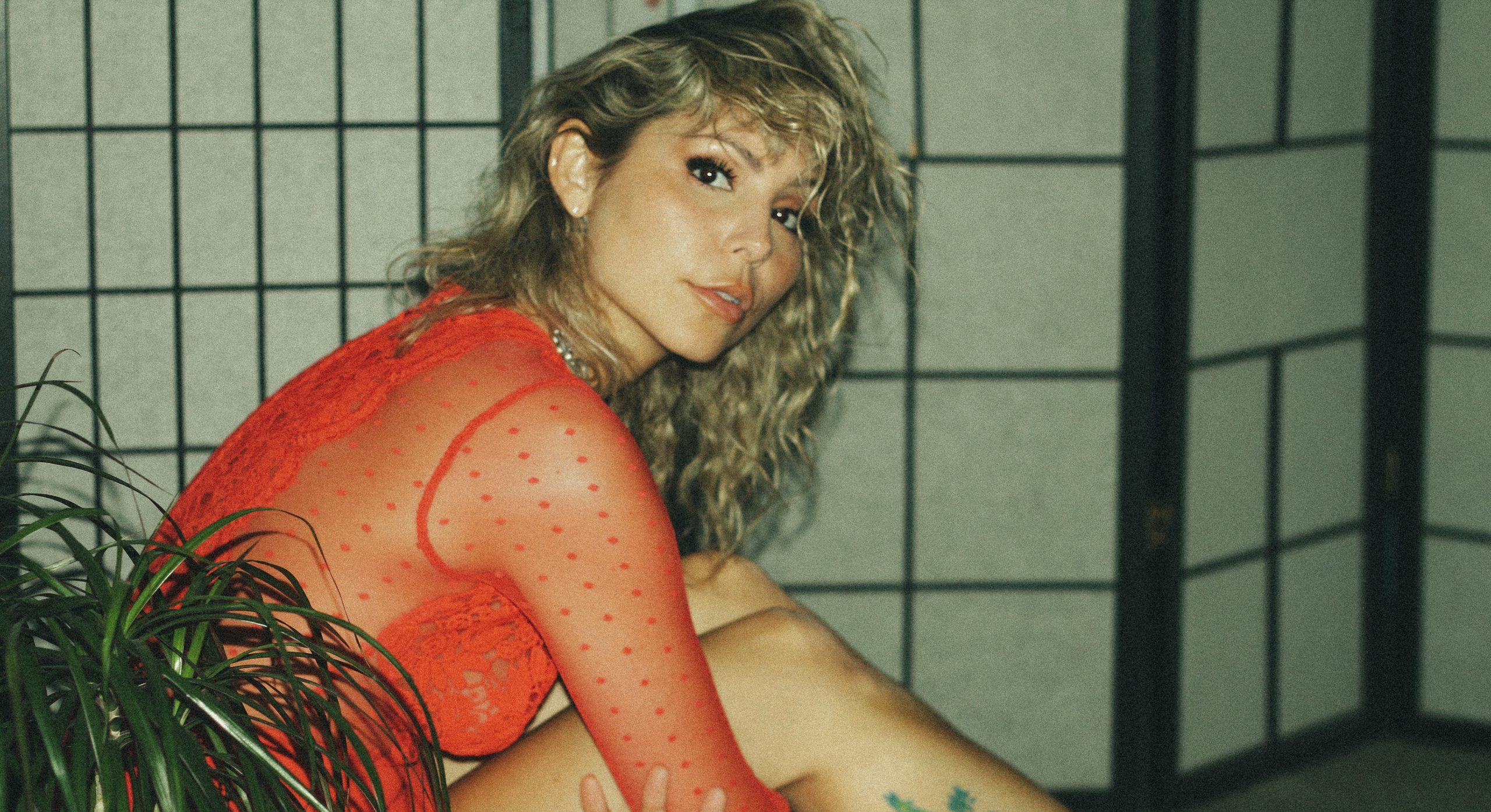
Jessy Covets isn’t your average bass music artist. Based in the States, the vocalist, songwriter, producer, creative and DJ has seemingly touched upon all aspects of bass music from low-end centered dubstep to heavier bits of D&B. Her journey has crossed cities, genres and corners of the industry, all connected by the genuine desire to connect and create with others.
Long before bass music became home, there were rehearsal rooms, girl bands, day jobs and a guitar – all part of the beautiful chaos of trying to make it in Los Angeles. Those formative years eventually gave way to production and a heavier world of low-end frequencies and electronic experimentation. Since then, Jessy has carved out a lane entirely her own, lending her voice to heavyweight collaborations with the likes of Champagne Drip, Levity and ravenscoon.
But the rave is only one part of Jessy Covets’ universe. Her relationship with sound stretches beyond club systems and festival stages and into the cinematic world of film scoring, where the usual boundaries of songwriting fall away and music becomes atmosphere, tension, vibes and story. It’s a space she describes as one of her most freeing musical experiences – proof that, for Jessy, creativity has never had limits.
Bass music has always thrived on pushing boundaries. Sampling, synthesis, sound design and experimentation are embedded in its very foundation, with entire movements born from artists finding new ways to reshape sound. For Jessy, that same curiosity extends beyond the music itself – exploring new AI tech while questioning the overall impact, protecting the human element and ensuring technology never overshadows the emotion behind the art. The tools may change, but the reason we create doesn’t have to.
Hi Jessy, tell us, where are you from and where are you at now?
I was mostly in LA, the Valley. Then I was in Burbank, next to Toluca Lake, which I loved! It was so much fun for me. Trader Joe’s, everything, was within walking distance from where I was.
Then, after the pandemic, in 2022, I left. It’s so crazy because I really didn’t think I was ever going to leave LA. From that moment, I kept traveling because I figured, ‘Well, I don’t have to be tied down to any specific spot.’ But Florida became my home base because my family is here.
Let me go back home for a bit…
I feel like I can finally breathe, and I think that gives my music a sense of freedom too. In LA, it was getting to the point where it felt like things just needed to get done – albums needed to happen, singles needed to happen, shows needed to happen. It became so much like a mass production, and I wasn’t very happy with overextending myself and losing the passion for my art.
Los Angeles has a way of staying with you…
Yes, that building stage for my career was established in LA. The good thing is that you can always return. I learned so much from living there, and I absolutely loved it – I had the best time of my life. It absolutely shifted everything in my life, from spirituality to musicality, everything. The people that I’ve met there will be my lifelong friends forever. The people, obstacles and moments you gained from out there become the fabric of who you are as an artist. I really, truly believe that. The connections and everything, they don’t go away. Until of course we all retire!
It’s good to be everywhere… having that freedom to record anywhere…
It was harder for me to fully walk away from LA. I really wanted to have one foot in and one foot out. But I knew that I had to make a choice… My boyfriend was like, ‘Why don’t you make Florida cool like LA?’ He’s like, ‘You know, LA is already cool. Make Florida ‘cool’.’ He said, ‘Start meeting people here, build communities here.’ And I have been. And the people are just as cool and just as fun and just as dedicated.
I mean, I remember living here in Florida (before LA) and being like, ‘I want to move to LA. My life’s gonna—it’s gonna change.’ And it certainly did. But who’s to say that can’t be anywhere, like Tennessee or wherever you might float to? You might go to Europe. Who knows? Ha.
Yeah, that’s a really good point. You can take what’s special about you wherever you go, and that’s part of being an artist. I really admire that sense of community and ‘let’s build together’, which is exactly what you’re doing. You’re everywhere – LA, Florida, Nashville, even the film world.
Then there’s AI… Your music had been used without your permission. Can you tell me what happened?
Well, I’m not exactly sure who stole what. But I went to the website The Atlantic AI Watchdog, and it lists all the different songs that AI used for training, taking my likeness, my writing, and my production without doing anything ethically or asking for permission. So that’s heartbreaking.
But I’m not the only person. I can’t believe how many people have had to face that reality. It’s really sad because, as artists, we fight for our rights to be seen and heard. We have something to say. We represent culture, emotion and identity, and we offer a critical perspective in so many ways in so many communities.
So, for that to be taken from us, synthesised, put online, and distributed without any limitations or accountability is incredibly difficult. I guess they’re getting some pushback now, so we’ll see how that goes.
It’s sad, but at the same time, I do value AI for a lot of reasons, and I understand why it’s there. But when it comes to my work specifically being stolen, I’ll be honest, I couldn’t bear going down that rabbit hole and finding out where my music might have been replicated. At that point, it wasn’t worth the time to investigate.
I thought, ‘The best thing I can do is prepare for what the future might be.’ How can I utilize AI? How can I stay with the times and understand what’s happening? Artists need to start copyrighting their music because that’s more valuable than ever. A lot of people don’t, including myself. I’ve made that mistake a few times, so… yeah, it’s definitely important.
Yeah, it feels like a grey area. Things still fall through the cracks, and it’s becoming harder to identify. It feels unregulated, especially when platforms like Spotify change their stance. What are your thoughts on that when it comes to production?
Absolutely, yeah. I really like what Rick Rubin recently said, which was along the lines of AI helping you create different iterations of your music. So, say you’ve just written a song, but you don’t really know what you want the final production outcome to be. You could maybe run it through AI. Obviously, that comes with the risk of running it through AI and giving away some rights. You have to look at what the terms are and what you’re up against before doing that.
If you wanted to utilize it in that way and you wanted to see how your song could be as a drum and bass mix, or all those different things, I think it’s really cool and it’s interesting, and it’s a good way to experiment. When experimenting with AI I wanted to know, what am I essentially competing with? So I’ve tested it and I thought it was really interesting and somewhat fun/funny, but to put it out and release it… I just… to me, it doesn’t feel right.
Exactly… it’s not authentic…
I just feel like that’s the type of thing where, first of all, I simply wouldn’t put it out, because I actually enjoy the process of making my own music. But, I suppose in a lot of ways it’s another tool to help you create music, as long as it’s done ethically/fairly/honestly.
If you’re going to create music, well, why are you creating it? And on another note, has music become such a competitive market that people feel like they have to constantly release, be better and faster, and put out endless content just to be successful—even if there’s no substance behind it? Is it really about the quality of the work and the perspective behind it anymore?
And the sad part is that there are people who have their life’s work online—people who have spent their entire lives learning how to play an instrument, write songs, produce, or develop their own sound—and now other people can just prompt something that draws from that work and say ‘Look, that’s my song…’
Insanity for them to call it their own….
Absolutely, I one hundred percent agree. But then people are putting it out and calling it their own “expression” when it’s undoubtedly drawing from other people’s hard work. And for what? What purpose does releasing it actually serve if you’re not going to follow through as an artist and develop your own voice, craft, and body of work?
Maybe some people don’t want the whole artist experience, and that’s totally okay, but regardless the system itself needs fixing. Companies like Spotify and YouTube need to get on board with protecting how this is processed and, most importantly, how people get paid for it.
Will.i.am was talking about this recently as well. I don’t know exactly how it would work, but he raised an interesting question: why should human-made and AI-generated music use the same MP3 and WAV file formats? Why not create a separate format or identifier for AI-generated music so there’s a clear distinction between the two?
And then Spotify is saying they can identify when artists have used AI because the person distributing the song has to disclose that AI was used in its creation. So, essentially, we’re relying on the honesty of the person uploading the music. TIDAL, on the other hand, has actually developed technology that can detect AI usage, and while it’s still not perfect, something is better than nothing, you know?
It does feel like AI is taking away jobs from real musicians and people that are actually grafting and trying. It can take so long to get to that point, to feel comfortable with putting out your own music. I think AI is diminishing the art of it.
I agree. I create music software with a company called Mixed In Key, and we’re very intentional about creating ethically. That means getting the proper licenses and permissions and working with hired human musicians and creators whose contributions are acknowledged and compensated.
That’s amazing! Mixed In Key is legendary…
Thank you. I love Mixed In Key. They’re great. We just released Wingman 3, and I spent a lot of time working on that with everybody.
That’s awesome, I love that. That’s a good segway into your Splice sample pack…
How did that come to be?
That was a cool sample pack, man. My first pack came at a time in my life – well, everyone’s life – when I needed it. My first Splice pack was in 2020! I landed it through Kate Wild, a girlfriend who had started working for Splice. She was a songwriter & vocalist in LA. She was like, ‘Hey, I know you probably need some money right now. It’s the middle of this crazy year. Do you want to make a pack for Splice?’
She was like, ‘Do whatever,’ and I was like, ‘All right.’ I’d always done electronic music, but I wasn’t making bass music back then. I was listening to it; but wasn’t producing it. So the fact that the hooks I wrote for Splice ended up on Levity’s ‘Neon Soul’ and Jekyll and Hyde’s ‘Wastin’ My Time’… I’m just like, ‘How the heaven does that happen? That’s so crazy.’
To me, Splice is an opportunity, but you don’t have to do anything you don’t want to do! Some people feel their vocals should be kept for their own project. I understand that in some ways. Back then, they didn’t really have parameters in place on Spotify to protect artists’ pages. I actually had to take my name off the Splice pack because people were releasing songs under my artist project name before I had even released anything myself. I had the craziest music showing up on my Spotify.
That’s wild…
It was nuts. Now they’re better about removing unwanted music on your page. Back then, it was a hassle for a year and a half to get it removed, so there was a bigger risk having your name on a Splice pack.
But regardless, it introduced me to so many brilliant artists. It’s a network in itself, and it can be scary in some ways because you’re putting your vocals out there for anyone to use. If I were to give advice to other vocalists, I’d say you have to decide if it’s something you’re willing to do. It will always be your choice. It’s your gift, your sound, your identity. But in my experience, I gained a lot more from it than I would have if I hadn’t done it. So I’m really happy that I did.
2020… Wow, that’s been a while.
I know, crazy. I’m working on a new pack with them now. I don’t know if I’m not allowed to talk about what we’re doing, but it’s really cool.
Producing is definitely your strong suit. But before bass music came into the picture, would you have considered yourself more of a singer-songwriter or a studio musician?
Yeah. I’ve been in a girl band since I was really young, and we’re actually still together. We’re called Peachy McQueen. That’s why I moved out to LA. We’re a three-piece indie blues girl band – Kayla is the drummer, Alayna is the bassist, and we were/are this power trio running through LA, trying to stay clear of all the craziness.
That’s what I did full-time – being in a band, playing shows, practice, slumming it and having a day job. Girl, it was crazy. Then eventually I was like, ‘I must be an adult. I must start producing music.’
That’s an amazing start, for sure. How did you get involved in film scoring?
My God, I love it so much. It’s so much fun. I’d joked with my friend for years, ‘We’re going to score a Bond movie.’ Every time we got in the studio for sync, we’d think about creating a James Bond theme song, so it was always in the back of my mind for sure.
Then my friend told me about a young director looking for a film composer. I’d never really done it, but I thought, ‘Okay, cool. I’ll try.’ We got on so well, and it was the most freeing musical experience.
I had come from songwriting, theory and more pop structured music, whereas film scoring is so dynamic. There are westerns, horror, psychological thrillers – the playing field is wide open. You get to be super weird, learn new cultures, software, sounds and experiment.
I was given an opportunity, I took it and believed in myself. Then I met amazing people online who gave me more opportunities, and one thing led to another. That’s why I believe people should take chances. Even if you don’t know how to do something, just try it.
No, not everyone is that open-minded. I think that’s part of what’s taken you so far – you have your hands in so many different things, but it all comes back to music at the end of the day, which can only strengthen your craft.
You know, Dr. Dre was like, ‘I’m not afraid of AI. It’s just a new tool for us to use, and we need to get used to it.’ He said, ‘I think the same person who’s afraid of AI might be the same person who was afraid of the synthesiser and the drum machine.’ Those things liberated his experience as an artist. They offered him a new way to create his feelings and musical intentions.
Personally, like you said, when I listen to some of the output from AI, I’m like, ‘It’s so cringe, I can’t listen to it.’I haven’t yet heard anything fully created by AI that made me think, ‘This is the best thing I’ve ever heard.’
Yeah, I don’t see it as a threat. It’s like when CDJs came along and vinyl purists resisted digital. There will always be people who resist change.
I agree. But we’ve got to talk about the potential monopoly in the market. What if Spotify decided to create playlists entirely from AI songs made and distributed by their own people? They could potentially filter everyone else out because the money would just go straight back to them. That’s a crazy thought.
It’s similar to when Live Nation bought up all those different venues. I can’t say I know enough about the details, but I don’t want to see something like that happen again.
These big companies and labels are making deals with AI companies, but why don’t we really know what those deals look like? I think there needs to be far more transparency. Most of what we see are headlines and broad summaries, but not the actual details of how these agreements work, who’s being compensated, what rights are being licensed, and what protections artists actually have.
The music industry has always been a wild ride when it comes to artists’ rights – even going back to Elvis. I don’t know what’s truly safe for musicians nowadays, and that’s what I want for us and everyone who creates. Fearless art and expression with transparency and fairness.The world would be dull without us.
Right. There’s already so little money on the table for artists, so to take away those earnings and give them to something that isn’t even human – ultimately putting that money back into shareholders’ pockets – is definitely concerning. That’s a really important point.
I hope that’s not the case. The concern is… okay, so now we have to use it, and then, for lack of a better word, become sheep to the market, to the grind, to the output. That’s craziness.
So I want to really think about, meditate on, and shift the conversation toward how we can make this industry truly viable and sustainable for artists at every level, across every discipline and every part of the creative process. Because without art, we have no culture.
I mean, on top of that, there’s education. I was seeing a lot of stuff about seniors in High School not being able to read because they’ve leaned heavily on AI over the last couple of years, and just the general decline in education. There was one thing on the news showing a mother looking at her kid’s school pamphlet – a young kid, probably in middle school – and the information was wrong. It had the United States map and the names of the different states, but they were completely wrong. They ended up saying, ‘Yeah, we used AI to create this piece of work that the kids would do over the summer.’
So I’ll always be open to advancements in technology. I think technological evolution is a beautiful thing in so many ways. I love synthesizers; I love technology in almost every aspect. I think it’s crazy, I think it’s cool. Look at us—we’re freaking talking on Zoom! That’s incredible.
But there has to be balance. There have to be safeguards, there have to be parameters, and there still has to be that deep connection to the earth and to our humanity.
What’s next for Jessy Covets?
I’m personally very excited about my future in music. With that said, I’m also deeply empathetic toward what’s happening in the world, especially in the years since the pandemic. I’m trying to remain as balanced, thoughtful, creative, aware, and hopeful as I can while continuing to grow my story as an artist.
I believe it’s our duty as creators to continue making art, even through the darkness.
I’ve been releasing singles all year, and I have an upcoming release on Monstercat with my friend NEOTEK, as well as a collaboration with one of my favorite artists to work with, ravenscoon. I also plan to release a bunch of new music over the next few months. I have an amazing collaboration with Sound of A1A that happens to be a really euphoric D&B record with a lot of bright, happy textures. I also have a very deep collaboration with my friend Labrynth that should be coming out soon.
I’m also working on film scores for a few movies with Chromosomes Music and Hudson Laird, I have a new Splice pack in the works, and I’ve been DJing in my spare time.
I do all of this because I genuinely love it, and I stay consistent because I’m dedicated to the art. I want to experience as much as I possibly can in this life. So… can’t stop, won’t stop.