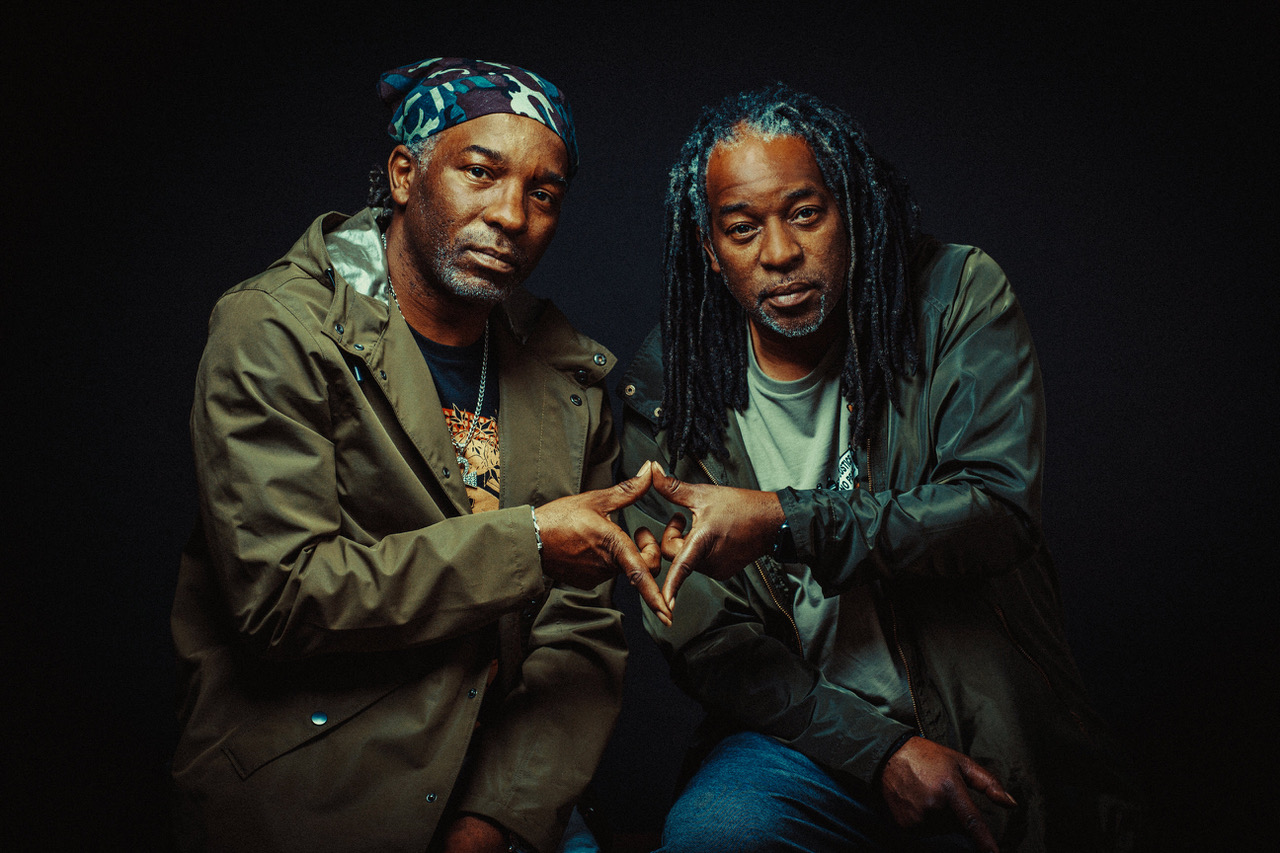
On 5 December 2026, Electric Brixton will celebrate a remarkable chapter in jungle history as legendary Hackney-born brothers Deman Rocker (David Dettouche) and Flinty Badman (Trevor Dettouche), aka the Ragga Twins, mark 35 years of influence on UK bass culture.
A decade before the emergence of jungle, the brothers were immersed in East London’s reggae and sound-system culture, drawing on their Caribbean heritage as they sought to make their mark with Unity Sound System. As ragga MCs, the microphone offered more than entertainment. It was a tool for expression, opportunity, and resistance, blending Jamaican musical traditions with the urban realities and political tensions of Thatcher-era London. Deman’s first single, “Iron Lady”, released in 1984 on Unity Records, perfectly captures the political and social climate of the time: “an anti-Margaret Thatcher skit built around the Stalag rhythm”.
As the limitations of their sound system success became apparent, the brothers turned towards a new musical landscape. Their transition into jungle produced the breakthrough album Reggae Owes Me Money in 1991, produced by longtime Hackney friends Smiley and PJ of Shut Up & Dance. The record became a meeting point between Jamaican patois, reggae and dancehall traditions, breakbeats and the rapidly developing sound of UK rave music.
The Ragga Twins became central to this cultural exchange, helping establish the MC as a defining voice within jungle. Their contribution was beyond adding ragga and MC culture to an emerging sound. They truly defined what jungle could become: a distinctly British music shaped by Caribbean heritage, sound-system culture legacy, and the socio-political realities of its time.
Their influence has since travelled across jungle, drum & bass, dancehall, dubstep and beyond. Yet their story is also one of brotherhood, resilience and independence in an industry that did not always recognise their contribution. From pirate radio to festival stages and international recognition, they have always remained connected to the culture that shaped them.
In this interview, the Ragga Twins reflect on the music that formed them, the sound-system culture inherited through their Caribbean roots, and the journey that took them from Unity Sound System into jungle, acid house, and beyond. From this conversation, we can consider what that heritage means today, how its traditions can be carried forward, and what the next generation can learn from the culture they helped build.
Thirty-five years of Ragga Twins is an incredible achievement. What does it mean to you to have kept going for so long?
Flinty: Although we’re primarily drum and bass and jungle artists, we’ve always done all sorts of genres. For us, it’s about staying in the music game. A lot of it comes from getting into music so young. In the beginning, you just love doing it. But if it wasn’t for music, I wouldn’t have seen the world. All those experiences are what keep us going. But inevitably, it’s always about the people. It’s never really about us. If one song or one event changes their life, that’s what matters.
Deman: We’re celebrating 35 years of Ragga Twins, but we’ve actually been making music for nearly 42 years. I think what keeps us going is simply the enthusiasm to carry on- full stop.
You both came from reggae and sound-system culture before becoming central figures in the UK rave scene. Where did that journey start?
Deman: When we were younger, my uncle had his own sound. When we went round to his house, we used to play and mess around in his sound room. I think that was where the idea of wanting to have our own sound came from. But when we were really young, just kids, we used to go to the sweet shop and ask for boxes. We’d draw an 18-inch speaker on them to make them look like a sound box. We always had sound-system culture in our blood.
When I left school, I started going out and getting involved with different sounds. When I went raving, I just fell in love with sound-system culture. When we started, we used to lift and carry the boxes, so I started right at the very bottom and worked my way up. It was great being part of a sound. You were part of something — an institution, a gang, you know what I mean? Although our sound didn’t leave the country, we still went all over the country.
The only thing that was missing from Unity in our days was travelling abroad. We would’ve loved to go America, Jamaica, or anywhere else that would have us. We never did any of that, and that’s probably the biggest regret I have from my Unity experience. Apart from that, it was one of the best experiences I’ve had in music. I got to go into the studio and record my first track, “Iron Lady”. If it wasn’t for Unity or the sound-system days, I don’t think you would’ve had Ragga Twins.
Demon Rockers – Iron Lady & Stick Together – Unity Records – 1984
Flinty: It was a little different for me. I’m a year younger than Deman, and when I was still at school, I built my own sound system with a couple of friends. We called it Sir Cruise. My uncle lived around the corner from my school, so we set the sound up in his basement. We’d go there during break times, lunch and in the afternoons to practise, and at weekends we’d throw our own little blues parties, with all our young friends coming down.
That’s really how I got into sound-system culture. I was listening to David Rodigan and Tony Williams at home, hearing the reggae and other music my mum and dad bought and played around the house, especially at the weekends while they were doing the Sunday cooking. As Deman said, we wanted to recreate what we were hearing on the big sound systems.
We had these little tape players with the piano keys, and we’d take them apart, extend the wires and build our own speakers. We’d even take speakers out of old TVs and put them into cardboard boxes. It was all very homemade, but that was our introduction to building and playing sound.
From there, I started MCing on different sound systems around Hackney. There were regular Friday-night sessions at community centres, and I’d go along with friends and get the chance to chat on some of the bigger sounds. Then I moved on to a sound in Tottenham, Gemi Magic Sound System, before joining Deman at Unity, where we started DJing together. Back then, MCs were called DJs. Unity was emerging as one of the bigger sounds in North London. I stayed there for a couple of years, and that’s really where things began to move forward for me.
You grew up in London during the ’80s and ’90s, when sound-system culture was such a defining part of the city’s musical landscape. Did you ever take Unity to Notting Hill Carnival?
Flinty: Ribs (Robert Fearon) was the owner of Unity. There were certain things he just never liked doing, and Carnival was always one of them. I don’t know why he never wanted to take the sound over to America or Jamaica either. We’d go down there, to Carnival, with other sound systems and chat — Jah Marcus, for instance. But I can’t remember Unity ever playing at Carnival.
I do remember one time when there was a Carnival-style event at Hackney Downs, but Ribs didn’t want to go. Even though he’s living in Hackney, the sound is in Hackney. We had to go round his house, beg him, and say, “Come on, let’s go, we need to be there!”
Saxon had come all the way from South London, but it was our area, you know? And we were thinking, this can’t be happening. Unity is the biggest sound in Hackney, and we need to be there! That was probably the one time he listened to us and brought the sound out. We played in the park, and it was something special because we’d never really done anything like that before.
Deman: I really remember that day because when he actually brought the sound to Hackney Downs, we had a beige truck. When that truck came through the park, people saw it, and everyone followed it to where we stopped, waiting for us to string up. They were even helping us get the boxes off the truck so we could start playing.
That’s what people wanted to hear — Unity, outdoors. We hadn’t really done anything like that before, so it was a big thing. Honestly, if it were my sound, I’d have taken it out of the country and played it anywhere. I would’ve done so much more with it. But Ribs just didn’t work that way. Still, that one time was wicked. People were talking about it for a long time afterwards.
You’ve continued that connection with reggae & dancehall since then too, including “Bacchanal” and your work with Luciano on “More Love”. Does reggae still feel like a central part of what you do?
Flinty: Yeah, that was “More Love” with Luciano. The original was done by us and Dean, and Reggae Roast did the remix. It was a really nice remix they did of the tune. We also went and did the video for it, which was great. It was really nice to do something like that again.
Deman: And actually, a little bit before that, about four or five years ago, we did an album with Wrongtom, In Time by Wrongtom Meets The Ragga Twins. The idea came from looking back at all the lyrics we had from our Unity days. We had so many lyrics that could have made an album, or even solo albums, but we never got the chance to do that at the time.
Wrongtom Meets The Ragga Twins – Bacchanal
So we came up with the idea of taking all those old lyrics from the sound-system days and putting them onto an album. Back then, they were all written down on paper, you know what I mean? These days, when we write new stuff, it’s all on our phones. So we had to go back through all the old papers, find the lyrics and bring them back to life. It was really exciting.
Flinty: There were still loads of lyrics that never made it onto the album, too. We just didn’t get enough time in the studio. When we were with Unity, Deman only got to make three or four singles, I got two, and that was part of the problem.
After the MCing and the sound-system days, we were always trying to turn ourselves from just sound-system DJs into artists. We always wanted to be recording artists. You had people like Tippa Irie and all those guys in South London making records, and we weren’t doing that. We wanted to be able to make records too, but we just weren’t getting enough opportunities to do it.
So, in a way, that became one of the reasons we wanted to move on and make music as artists, and move over to jungle.
With Reggae Owes Me Money, is the title hinting at some of those experiences you had with the reggae industry?
Deman: Yeah, absolutely. You got it. We had a rough time dealing with the reggae music scene. It wasn’t so much reggae music’s fault; it was the people managing our careers at the time.
I remember speaking to a Coxsone guy, and he said, “If you and your brother were on the Coxsone sound, you’d be in the studio every day. Your lyrics wouldn’t be going to waste. We’d be recording you every day.” I thought, “Blimey, maybe I’m in the wrong place.”
Making Reggae Owes Me Money came about after me and Flinty sat down and said, “This is our last dance for Unity.” That was 31 December 1989. We just said, “We can’t do no more of this.”
We were working Thursday to Monday, all weekend, doing long hours, and we weren’t really getting anything out of it. It wasn’t worth our while. Other people were getting more out of it than we were. I still loved what I was doing, but there’s only so much you can do when you’re not getting paid properly for it. We both had jobs anyway, so we were working alongside the sound.
Then one day I was at work, and Smiley (Carlton “Smiley” Hyman) from Shut Up and Dance came to see me. He said he wanted to use a sample of my voice from Unity, and I said, “Yeah, no problem.” Then I said, “Well, I’d like you to do something for me. Can we come and do some recordings?” He said, “Yeah, come and see me.”
But I told him, “Listen, I don’t do anything without my brother.” Because my brothers and I have always rolled together. From when we were young, we’ve always done things together. I said, “It’s got to be my brother and me.”
So we went up and saw him and started talking about it. PJ (Philip “PJ” Johnson) was someone we already knew from primary school, so it all just fit together. He told us what he wanted from us, and we told him what we wanted from him. Then he said, “I think you should be a duo, not solo artists.”
Flinty: We weren’t really thinking like that at first. We’d spent so long building ourselves as individual artists on the sound system, and that’s what we knew. When we looked at reggae, we mostly saw solo artists. There were a few duos, like Michigan & Smiley, but it wasn’t really what we were thinking about.
But they said to us, because they were a duo themselves, that it would be stronger if the two of us came together as a duo. Then they said, “You need to find a name for yourselves.”
I think I said something like “Ragga Twins”, but we were still going through names. We still wanted to be Flinty Badman and Deman Rockers, but we just needed a base name. “Ragga Double” didn’t work.
And even though we’re not twins, people get confused when they find out. We’re brothers, but we’re not twins. “Ragga Twins” just worked because there were two of us, and “Ragga” came from where we came from.
The production on Reggae Owes Me Money was already moving in a different direction, with Shut Up and Dance bringing in hip-hop and electronic influences. Did you feel that you were developing something that would eventually lead into jungle?
Deman: Yeah, they were already doing that because they came from sound-system culture as well. They had a sound that used to play against Flinty’s sound when we were at school. We’re all pretty much the same age, and they were raggamuffins as well.
Having us there, they knew what they needed from us, and we just gave it to them. They’d play us the tunes and, to tell you the truth, we can chat on any rhythm. It doesn’t matter. We can chat on any genre. So, when they played us the tunes, at first we had to get used to them, but once we did, it wasn’t a problem. I didn’t find any difference between what they were making and what we were doing on the sound system.
Flinty: They already had the formula worked out. They said, “We’ll do the dancefloor stuff” — the “Hooligan ’96”, “Spliffhead” and those kinds of tracks — “and then you guys can do your thing over the reggae and hip-hop-influenced tracks.”
That’s where we could really express ourselves, with tracks like “Love Talk” and “Illegal Gunshot”. Then, on the dancefloor tracks, they might just use a sample of our voices.
When we did “Spliffhead”, for example, we were in the studio saying all sorts of stuff over the rhythm. Then I said, “Ragga Twins dem bout,” and they were like, “That’s it. Come out the voice box. We’ve got it.”
I was like, “What do you mean, you’ve got it?”
“‘Ragga Twins dem bout.’ That’s gonna be it. That’s all we need on the rhythm. Put that on repeat.”
And so it was. They knew exactly what they were doing; they knew what we could provide, and it all worked.
Did you ever find yourself preferring jungle or drum and bass to reggae?
Deman: No, not at all. The funny thing is, when we got into acid house — not even the jungle part yet — after our shows we wouldn’t stay and rave. We’d leave and go and find a reggae dance to rave at.
That all stopped around 1991, when we stayed at a rave after one of our shows. That was it. We just started raving from then on. So we became ravers, as well as musicians.
But I wouldn’t say I preferred acid house, jungle or drum and bass over reggae. I like them all the same.
I’ve read that going into the rave scene was something of a culture shock, particularly seeing a completely different demographic responding to your music. What was that first experience like?
Flinty: Well, first of all, after putting out the album and the two singles, we started getting shows. Our first show was in Birmingham. Smiley called us up and said we were going to get paid £1,500 in 1990. We thought, “We’re gonna get paid what!” So that gave us a bit of a boost, knowing that we were going to be earning proper money from the music.
Then we got to the event and looked around, and it was just white people. We didn’t see any Black people. We were coming from a predominantly Black genre, doing reggae, and suddenly we were thinking, “What are we gonna do here?”
We didn’t even know what we were going to do. We had our younger brother as our DJ because he was a sound-system man, so we had him playing our tracks. Then the compère announced, “Next, you have Ragga Twins,” and when they made that noise, we were like, “Oh, we’re alright, yeah? They know us!”
We had no idea how well our tunes were going to go down. We’d come all the way from London thinking, “Nobody’s gonna know us. Ragga Twins, who are they?” But they knew the tunes. They were going mad.
We did pull-ups and everything, and at the time nobody was really doing pull-ups at those shows — rewinding the tune. We brought all those reggae elements from sound-system culture into our shows. Eventually, that became part of what would lead us into jungle.
What would you say was your most memorable moment from those jungle years?
Flinty: For the jungle days, it would probably be Kool FM’s third birthday bash at the Astoria. Kool FM was a radio station, and they packed out the Astoria and shut down Charing Cross Road. It was just amazing.
We had to fight our way in. We got there around ten, half ten, and we had to push through the crowds to get inside. We knew a few of the security guys, so they had to part the crowd for us.
When I look back at the old footage from the ’90s, it just looks insane. I don’t think you can replicate that kind of energy. People were blowing whistles and horns. You could hear the music, but on the video, all you can really hear is the crowd. It was crazy. And just to know that we were pioneers in that sound, right at the forefront of it, and to see how it built up, and that we’re still here now, still getting bookings 35 years later is amazing.
Deman: It is amazing because, I mean, I’ve had my accident, and I don’t want to dwell on that, but they still want me up there. They still want me and my brother together on stage. That’s lovely. It gives me so much energy when I’m up there on stage with my brother.
I’ve always loved it. Doing what we do brings us a lot of pleasure.
Going back to that first rave in Birmingham, I remember when we got to the club, and they put us in a room. There were two tables covered in sandwiches, fruit, crisps, sweets, nuts — everything.
I looked at Flinty and said, “Who’s this for?” One of the promoters came in, and he said, “Eat and drink what you want.” I thought, “My God, this is how you get treated?”
For about three or four years, everywhere we went was like that. It was a real eye-opener, you know what I mean?
Flinty: It was like, “Oh, we’re proper artists now.”
On the sound system, we were DJs. Suddenly we were like, “I’m an artist.” That’s what it felt like. And we didn’t really pick up on everything straight away. We’d hear BBC Radio and Kiss FM playing our music, but we didn’t immediately realise what that meant.
We just knew we wanted to do this. We wanted to make music, put it out there and perform. We weren’t thinking about all the other sides of the music industry. That came later, when we started to realise, “Oh, we’re not just DJs anymore. We’re proper artists.”
You also had a strong involvement with pirate and commercial radio. What are some of your strongest memories from that period?
Deman: One of my best memories was Steve Jackson on Kiss FM in 1991. He was a popular DJ and used to play acid house on the radio. Kiss had just turned legal, and he asked us to host his show while he was on holiday. The Ragga Twins hosted it, played the tunes we wanted to play, and it was wicked.
Another one was after the Kool FM Astoria rave in 1993. The next day, all the DJs and MCs involved with Kool FM went up to the radio station. It was absolute chaos! Everybody was up there chatting, talking about the night before and being on the radio.
Flinty: Also, we did two sessions with John Peel on BBC Radio 1. We performed live on his show, and he actually ranked our session among his top five. That was a big moment for us because John Peel is such an important figure in music and radio.
How has it been watching drum and bass evolve through so many different phases while you’re still performing within it?
Deman: Drum and bass always goes through different phases — different basslines, different beats and different styles. You always get a different sound coming out. It depends on who’s making it. You’ve got DJs that make rollers, and you hear it and think, “My God, that’s a tune.” Then you’ve got producers who just make a lot of noise. But people like it, so there must be an audience for it. I just like my drum and bass to be rollers. I don’t like too much noise. I don’t like festival drum and bass. Can’t stand it.
I guess the soul in the music, and its Black roots, got sucked out.
Flinty: I know exactly what you’re saying. But we’re generational. People might look at us and think that we only engage with the older generation, but we get so much love from the younger generation too. I don’t know if it’s because of their parents, but the younger ones love drum and bass, and they want to hear us on it. We can chat on any genre. We do it for the people.
But at the same time, the old-school elements always come back around. In ’95, there was trouble in jungle, and the music changed. The reggae samples were taken out, and the soul came out of the music.
Deman: This is the truth too. They took it out because, around ’94, ’95, ’96, there was a bit of trouble in jungle. There were people coming into dances and bringing their beefs and grievances into the dance.
So some producers and DJs thought it was a good idea to take the reggae out of it, thinking it would stop all these people coming. And, well, it did, because there was no more soul to the thing.
They tried to bring in this thing called “intelligent drum and bass”. What was intelligent? Are you making it on a more expensive computer? Nothing intelligent to me.
They called it drum and bass, but you can’t call it intelligent when it’s just a drum and a bass!
But as the years went on, they had to bring the reggae and the soul back. And the thing is, over the years, jungle just got stronger. The younger people are listening to the same beats from the ’90s.
You could’ve killed a whole genre.
So what did you achieve? The same music you didn’t want to play is still here, bigger and better than ever. For me, nothing was achieved. They tried to kill jungle, but it didn’t work. And the same people who were trying to kill jungle have come around now; they’re still playing at jungle raves.
Flinty: They’re playing the same music now that they tried to disregard and throw away back then.
Deman: It doesn’t make sense, and they’ll never admit it! They tried to kill a genre that we helped invent.
I feel like there was maybe a lot of elitism going around, or an attempt to make something new by belittling something else.
Deman: Yeah, exactly. That’s what they did. Some people were calling the music rubbish and saying, “It’s throwaway music; it’s time to change it. It’s not going to last.”
But it’s still here.
Maybe it was supposed to happen that way.
Everything that happens is supposed to happen. It’s God’s way.
We had a rave the other day called Back to ’93. My God, the oldies came out! They still came out, and this was music that, to some people, had been dead for years. But it hasn’t been dead.
Those people don’t come out every week. They wouldn’t necessarily come out to a new-school event, but when you put those old tunes on, they come back.
How can you try to kill a genre that had tunes like “Leviticus” and “Dirty Games”? All those big tunes. It just doesn’t make sense.
And the intergenerational celebration is one of the most magical things — seeing all different ages in one place, enjoying the same music. How do you guys feel about that?
Flinty: I feel like we’ve played our part. As I said, I feel comfortable with what I’ve done. I don’t regret one tune that I’ve ever made. We just love everything we’ve done, and we’re just glad to still be here.
We get messages from people who never knew anything about reggae. Maybe they lived somewhere up north and had never really been exposed to it. Then we came along doing reggae over acid house music, and they heard it on the radio and liked it. Now they love reggae. They’ve gone away and researched it, and they know everything about it.
Just knowing that we’ve introduced people to something new in their life, something they never knew about before, means a lot.
I think it’s very important to acknowledge the cultural legacy of where the music came from — the historical lineage, the roots in sound-system culture and the Caribbean, and seeing where that has developed.
Deman: Yeah. We brought a lot into this genre. And when I say “we”, I mean we- Ragga Twins, Navigator, Sweetie Irie, Tenor Fly, Tippa Irie, General Levy.
We brought things into the scene that people hadn’t heard before, things they might not have known anything about, different sayings, styles and elements from our sound-system culture.
I think we gave a lot to acid house. It gave us a lot too. We got to travel, perform and do things that, without this genre, we might never have had the opportunity to do. But we also brought a lot to the genre — the sayings, the styles, the culture and all those little things that came from sound-system culture.
What are you guys looking forward to at the Electric Brixton on 5th December?
Deman: It will be our second time celebrating an anniversary there, because the first was for 25 years. We’re looking forward to sharing the stage with all the people we’ve worked with over the years, people we’ve made friends with and people who have been part of the journey.
It’s about giving something back to the people who have supported us for 35 years.
Is there anything you’re looking forward to continuing to do in music?
Deman: We’ve made music, we’ve done albums, singles, performed live, we’ve actually done everything. But I wouldn’t mind playing in Brazil or South America.
Flinty: I just want to carry on making good music. They say that when you get to 61, your music life is supposedly coming to an end. But I don’t feel like mine is coming to an end. I feel like I’ve still got a long way to go. I just want to carry on making music.
Do you see yourselves returning to reggae or sound system at all?
Deman: I don’t see us returning fully to sound-system music, but yeah, I’ll do a reggae track. I just don’t trust the producers!
Flinty: We just want to keep performing. On behalf of my brother, we want to get him back on his feet, that’s the main thing for him. But getting him out there and performing gives him energy and gives him hope.
We’ve also got an album coming out soon. There are a lot of featured artists on there: MC Spyda, Tippa Irie, Tenor Fly and more.
We’ve got a lot of dubstep stuff with American producers. They’ve always been on us because when we did that track with Skrillex, the dubstep people started calling the boys of brostep. Haha!
Recently, we did a track with Barely Alive, and the messages we were getting were crazy, brostep people saying they wanted us to bring back the old-school ragga and breakbeat sound.
And we’re going to test out this new genre. I don’t even know what it’s called, but it’s like a 4×4 thing that’s going on, garage, bass, drum-and-bass-ish. A lot of the young DJs are playing it in their sets, so we’re going to dabble in that and see what happens.
You’ve also got the 35-year celebration coming up in December.
Deman: Yeah, we were meant to do it last year, but because of my accident, we never got it done. So technically it’s 36 years this year, but we’re still celebrating 35. We’ve got some special tracks that people love, and then we’ll jump on with the other MCs and just have a big party.
Are there any other artists we can expect?
Flinty: There’s no one really out of the blue. It’s all quite logical. There’s no one where you’d think, “Wow, he doesn’t play jungle or D&B, but he’s here.” It’s mainly people from the scene and a lot of the guys we’ve worked with over the years.
It’s also my mum’s birthday. When they first gave us the date, we thought, “Ooh, this might be a bit awkward.” But then they said it was going to be 5 December, and we realised that’s Mum’s birthday. So we’ll be celebrating Mum as well as ourselves.
Is there anything else you want to throw out there?
Flinty: There’s not much. Just keep your ears to the ground for what’s new with Ragga Twins coming up, and follow us on the socials. We’re trying to build our YouTube page, so if you can subscribe to the YouTube page, people, please do. It’s Official Ragga Twins on YouTube.
We’re just keeping it moving. We’ve done a lot, innit? We’ve done everything. What more can you do? At our age, it’s about how you keep yourself ticking over, keep yourself up to date and keep supplying material for the people. Because it’s the fans that keep you going. And just creating more love and happiness in this world. More blessings.