
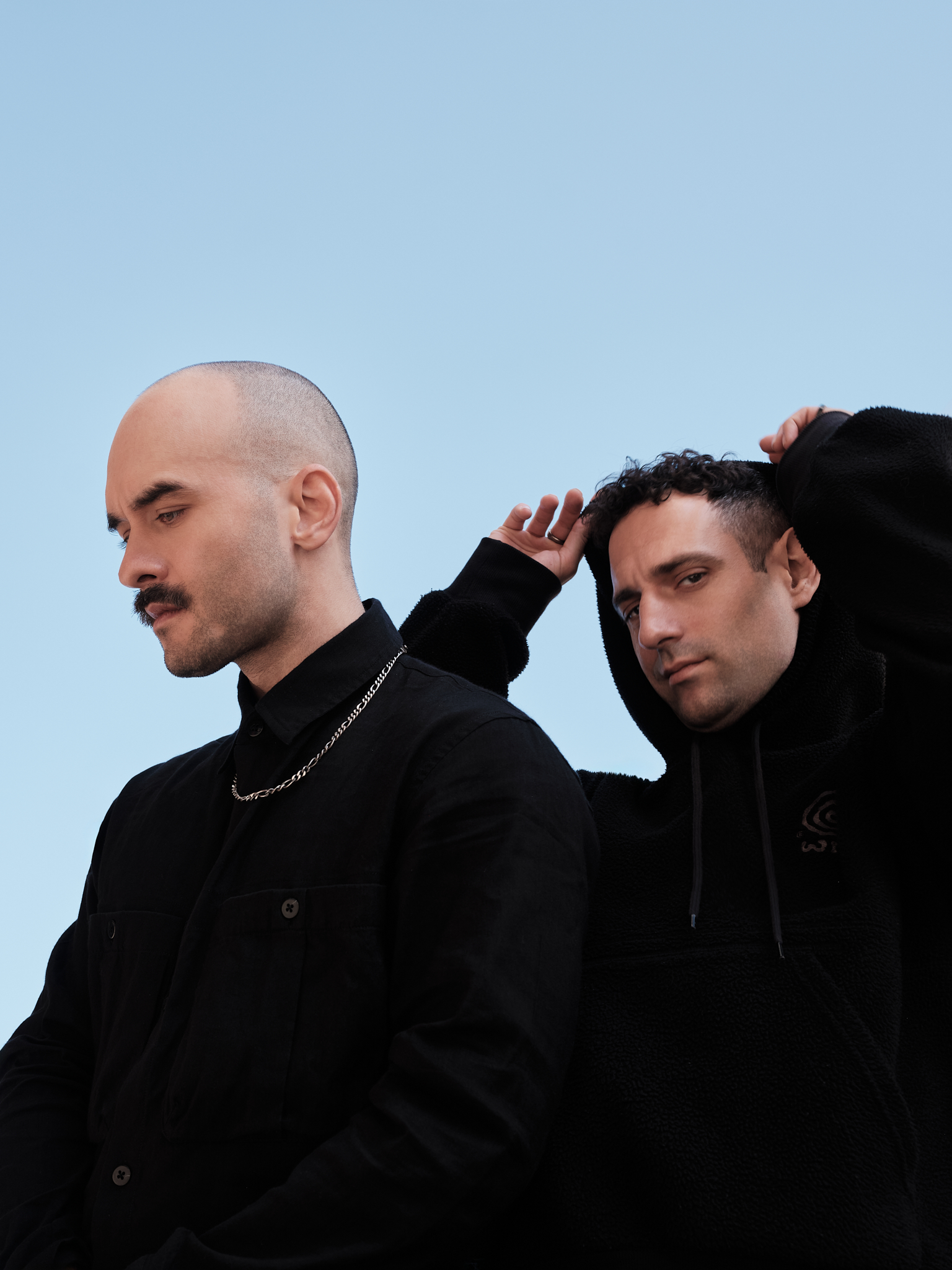
Three years after their debut album, QZB is back with “Dreams to Dust” on Critical. This time with more focus and a clear vision, which explains why the production process only took a few months. It’s a story of trust, confidence, collaboration, and self-expression.
Unlike their debut album “Future Forever”, they now took all matters into their own hands. They recorded all vocals in their own studio rather than working online, and were able to tell their own visual story. This resulted in a very personal story. “The visual language builds on fragility. We are very emotional people, and tried to incorporate all of these feelings,” Ben explains.
With “Dreams to Dust”, QZB embraces imperfection and honesty, but brings immaculate storytelling and production nonetheless. Time for a chat!
Congratulations on your upcoming album! How is it living towards the release date?
Thomas: There’s always this weird phase between finishing something and it releasing, especially with how long vinyl takes. We’ve been listening to the album way too much at this point, so it’s nice to have a break until it gets released publicly. At the same time, it’s nice as well to have the final versions of the tracks and being able to play them live. Seeing people react to it for the first time after we’ve been keeping it to ourselves for so long is always special.
Ben: We do all the visual parts ourselves, the video campaign, all the assets…The whole world building came from our team and us, and the whole process is like sending a child into the world. You nurture it and you give it all the things that are needed to succeed. After a certain date, the 2nd of October in this case, it goes out and is part of the universe.
Thomas: We are very happy with what we made, which is the most important thing for us.
You’ve had time to test it out over the summer. How were the reactions?
Ben: We already started to test it out in April. The production process for the last album took ages. We had announced it very early and everybody was constantly expecting it. This time everything was much more condensed. We knew what we were sitting on and what we had. The album is a personal piece, especially as we really tried to match that fine line between accessibility for people to dance to, but still have a big emotional value to it.
You’re saying how your last album was a long time in the making, and this one took much shorter. What was different this time in the process?
Thomas: First of all, what we learned from the first album was a big part of it, just as knowing how we evolved and how we work nowadays. We started with a lot more focus. We waited until we were sure that we wanted to do another album. What also helped us was that we did all of the recordings for the vocals in the first two months. That helped immensely with having a backbone of the album ready from the very beginning. It was such a different feeling this time, even though it was even more do-it-yourself than last time. It was in a way, way more work because we did more vocals and we did everything in our studio. Last time we had a lot more online collaborations, with sending vocals back and forth. This time it was a lot more working together, bringing all the vocalists into our studio, working with them on the tracks and then doing all the comping with them in the room and really developing the track and the vocals for the track together. This is something we weren’t able to do with the first one.
Ben: The album is centred around the narrative of self-development, and in the last few years, we grew a lot on a personal level, on a collaborative level. We have been making music together for more than a decade now. You go through phases and at some point, sometimes you develop in different directions, but you always choose each other. Leaning into that and having much more confidence after, we made a big step in our career during the last few years. The trust in each other and towards our work has deepened and has become more elaborate than it was with the first one.
Thomas: Last time we put a lot of pressure on ourselves. It probably didn’t help that we were announcing it three years before releasing it, and with it being our first album, all of that came together. This time, we felt a lot less pressure because, when we started it, people didn’t know about it. We were much more in control of everything, including the messaging.
In the past few years, what have you learned? How have you evolved?
Ben: Trust is more important than control. An intense perfectionism and “overcooking” something, it feels constructed and then you hide behind your work. You hide behind perfection. Perfection is admired, but we leaned more into honesty. We trust each other and we trust the process. We trust the skills. Hence, we felt like leaning into the whole confidence part. As Thomas said, writing lyrics the first time, really leaning into songwriting instead of polishing sound design was a refreshing take.
There’s a quote from you: “For years we chased perfect and this time we chased true.” It summarises what you’ve been saying. This time you’re just staying true to yourself, keeping it close to what you actually want to do. What does that mean to you, staying true to yourself?
Thomas: We try to care less about what other people think, what the trends are and what is expected of us. I’ve realised that the only other input that I actually need, apart from my own, is Ben’s. If it’s filtered through both of our lenses, then it’s exactly the picture that we want. We wanted to get away from what people think of our music, want from our music. It’s something that we earned through what we’ve done before. We’ve always paved the way to get to this position where we’re like, we can do the techie rollers, we can do the minimalistic stuff, but we want to do whatever we want to do at that moment. We hope that people will follow us, and so far, they always did.
Ben: To elaborate on that statement, true means honest. You can see it in the visual language, which builds on fragility, on bodies, on skin, vulnerability, weakness. This is our world, this is what we feel as grown men. We are very emotional people, so we reflected on that as well and tried to incorporate all of these feelings. Not in an upfront way, not in a particular statement way, but in the meta, in the texture, in things that are graspable and leave enough room for another person to resonate with it.
Where is that line for you between, I’m doing it for us and I also want it to be heard by others?
Ben: We want to tell stories and we’re good at creating something that leaves enough room for people to make their own story in it. Part of the process is the execution, the production itself. Of course we consider, is another person able to resonate with that? But, if you just give all the narrative in front, all the interesting parts of it are lost. For the audience, as well as for the person who does it. If it leaves enough space, which we intended to do on every track, it can hit this fine line between accessibility and authenticity.
Thomas: We’ve written this album for ourselves, but that doesn’t mean that we don’t want people to hear it or experience it. The beautiful thing is that everyone who listens to our music, they all have their own stories and connections. They think of different colours when they listen to our music. They listen in different situations to different tracks. The best way to create is to do what we want first, and afterwards to listen to the stories it creates. Once we release something, that’s when we want to hear those stories. We want to see how people react to it and we want to hear how people feel about that music. It’s two very different sides. The first thing is, it’s in our bubble and we do our thing and we need to protect that without too much influences from outside. The other part is hearing those stories once it’s out.
What did “giving up” on perfection mean to you creatively?
Thomas: It was more a profound understanding that there is no true perfection. There is beauty in any sort of imperfection, and we learned that, no matter what we do, people will connect to the music in very different ways. We used to think about it way too technically, very much in a producer and technical mindset. This album feels much more organic, more human, which is probably a good thing, especially in the times we live in. There’s a limit to how far you should go and other things are more important than getting the technicals perfect.
Ben: As I mentioned before, perfectionism is a certain fear. You try to control the outcome of something and once you give up on trying to control everything, everything feels much more free. That freedom bounces back onto your creativity and it opens up more possibilities. Then you’re able to experiment, break conventions, and lean into something that you wouldn’t have done beforehand.
If you could tell your six-year-younger self something, when you started your first album, what would you tell them?
Thomas: A big part of it is living through it. I’d probably say it’s all fine, just keep going. Everything was worth doing it the way we did. It was also important to, because the first album, the way we used to work, and how we developed to that album, that’s important for our development as people, but also as artists. I wouldn’t do anything differently. The way we’ve done it is exactly how I wanted it to develop.
Ben: A lot of people get pressured to stay hot, to stay relevant, and to make it over-efficient wherever they want to go in life. When you’re living in Switzerland/ Germany, it’s quite hard to live off drum & bass, especially if you don’t want to compromise yourself. Knowing this brings you into a very different position. Unless you’re very established and gaining big coin off of shows, it’s technically impossible. You have to let that go, stop overthinking, and take your time every now and then, smell the roses, and trust your skills and confidence. The main part of this album is that this is a form of self-expression. We express ourselves, and there is an inherent need to do that. Even if nobody would listen, we would still do that. It’s the language we are most capable of.
Beautiful! Do you have any gigs coming up or projects that you’re working on which you can already tell us about?
Ben: We’re going on tour from the album launch until the end of the year, big club shows all around Europe, and we’re going back to Oceania next year. We’re looking forward to enjoying the feedback of fans and enjoying tour life. And, you heard it here first, but the next project is going to be all techy again.
Thomas: After coming out of such a big project, it’s funny to see how it doesn’t even take 24 hours until one of us has an idea for what we want to do next. That’s probably the coolest thing about being done with a project and that in-between phase between us finalising it and it coming out. Now we have time to experiment again and not overthink it.
Anything else you want to share?
Ben: Thank you, Critical Music, for believing in us and for giving us the platform. Without them, it wouldn’t be possible to get the freedom to make such a project. And Big ups Kasra, Badger, and Kira, they are amazing, and love to our family.
 READ
READ